
Ancient Roman Stadium of Philippopolis (present-day Plovdiv) – one of the most impressive and important monuments from the Roman era in Southeastern Europe

The ancient Roman stadium of Philippopolis, located in the heart of present-day Plovdiv, is one of the most impressive and important monuments of the Roman era in Southeastern Europe.

Ancient Roman Stadium of Philippopolis (present-day Plovdiv) – one of the most impressive and important monuments from the Roman era in Southeastern Europe
Its monumentality, strategic location and direct connection with the imperial cult and the provincial administration make it a key source for understanding the political, social and cultural role of Philippopolis as the leading city (metropolis) of the province of Thrace.
Historical context and chronology of Philippopolis – strategic importance and imperial patronage
Philippopolis – capital of the province of Thrace and city prestige
Philippopolis (so called since its founding by Philip II of Macedon) established itself as one of the most significant urban centers in the region, defined by the ancient author Lucian as the largest and most beautiful of all cities.

After the establishment of the Roman province of Thrace in 44–46 AD, although not the original capital, Philippopolis rapidly grew in importance, becoming the seat of the League of Thracian Cities (Seuthopolis, Kabile, Gelis (Helis) in the area of the present-day village of Sveshtari, Beroe (present-day Stara Zagora), Pistyros near present-day Vetren, and others). The second century AD was a period of unprecedented economic and urban prosperity.

The city expanded its borders beyond the traditional three hills to the plain and even gained the right to mint its own coins. This high status as a metropolis and center of the provincial assembly was fundamental. Investing in monumental infrastructure such as the stadium demonstrated not just local municipal initiative, but direct imperial approval and a significant financial resource necessary to maintain the city's prestige within the Empire.
Dating and Imperial Construction - Hadrianic Period (2nd Century)
The construction of the stadium began in the early 2nd century AD, during the reign of Emperor Hadrian (117–138 AD). Emperor Hadrian was known for his policy of strengthening the borders and integrating the eastern, Hellenized provinces through monumental construction and the promotion of cultural agons. In this way, the stadium of Philippopolis served as a direct instrument for demonstrating, affirming, and instilling imperial loyalty and civilization in Thrace.

The stadium's political function continued into the 3rd century, when emperors such as Septimius Severus, Caracalla, and Elagabalus visited Philippopolis. Special sports games were organized in their honor, emphasizing the facility's role as a platform for the glorification of imperial power and benevolence (munificentia).
Use and final decline
The stadium functioned actively as an arena for various spectacles and athletic competitions during the 2nd, 3rd, and most of the 4th centuries AD. Its functional life ended with the gradual decline of pagan cults and games towards the end of the 4th century.

This is directly related to the decisions of the Christian emperors, in particular the ban on the Olympic Games and their associated pagan rituals by Emperor Theodosius I. After its closure, like many ancient structures, the stadium was abandoned and gradually buried under the layers of the medieval and modern city.
Architectural analysis
Dimensions, capacity and athletic purpose
The stadium is monumental for the scale of a provincial city, with an approximate length of 240 meters and a width of 50 meters.
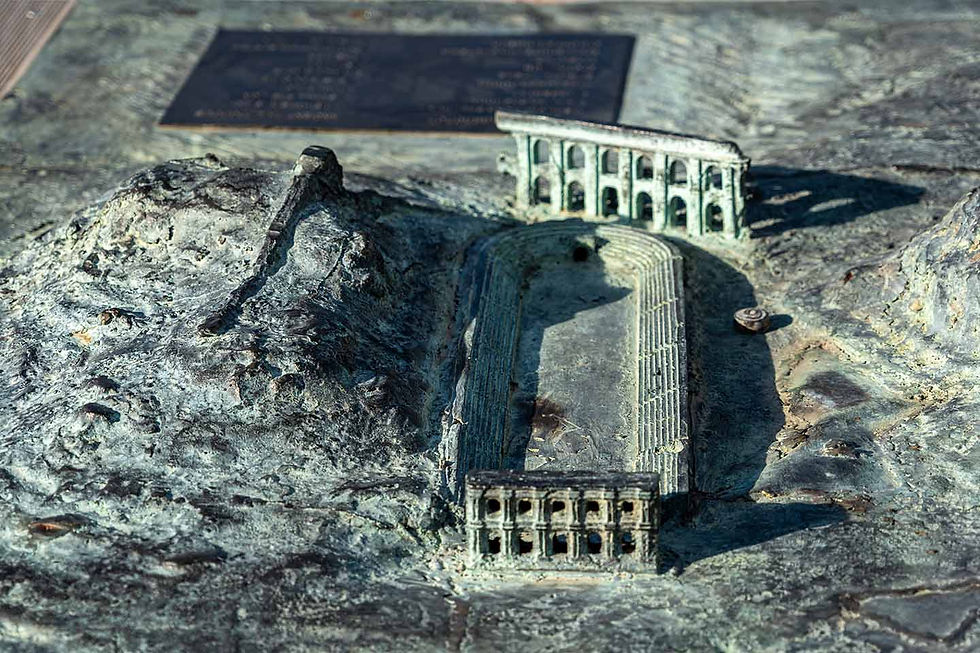
The length of the racetrack itself was equivalent to one Roman stadia (600 Roman steps) or about 230 meters.

The facility was designed to accommodate an impressive 30,000 spectators, which emphasizes its exceptional social and political significance in the context of the metropolis.

An important architectural feature is the relatively small width of the track – about 32 meters. This parameter is a reason to conclude that the stadium of Philippopolis was not intended for chariot races, as they require a much wider track (typical of circuses).
This architectural limitation suggests that Philippopolis' focus was primarily on classical athletics (such as the Pythian Games) and gladiatorial combat. This choice, in contrast to the expensive and mass circus format, speaks of a desire for cultural prestige associated with ancient Hellenic sporting traditions, which is typical of cities with a deep Hellenistic heritage in the Eastern part of the Empire.
Geographical location
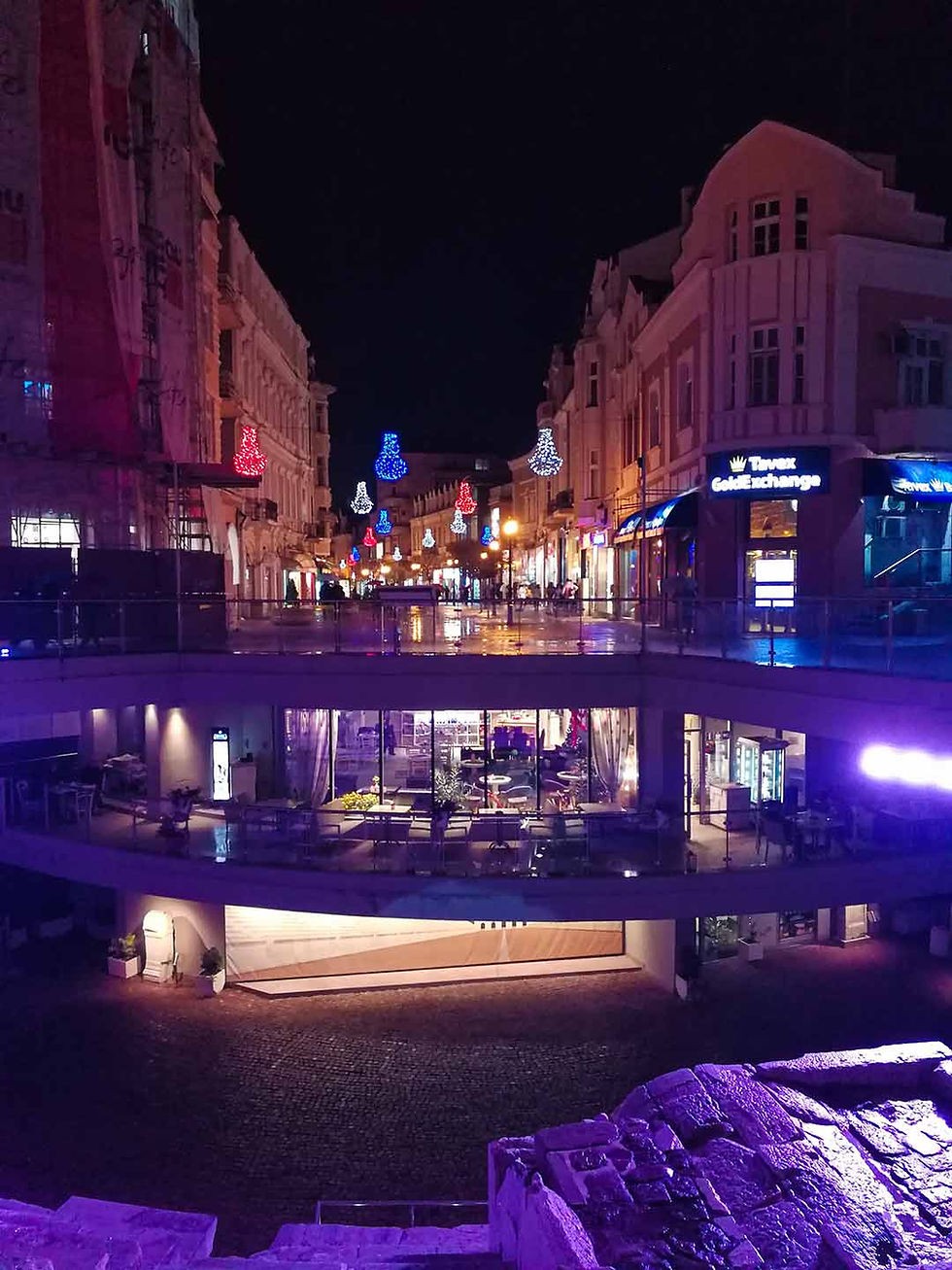
In terms of urban planning, the stadium of Philippopolis is extremely atypical. Unlike most Roman stadiums, which were located outside the city walls, the one in Philippopolis is located inside the fortified city, at its northern edge. It was built using the natural depression (fold) between two of Plovdiv's hills - Taksim Tepe and Sahat Tepe.

This rare placement emphasizes both his high political prestige and the need for protection.

Archaeological excavations have revealed a section of the 2nd-century defensive wall (repaired in the 3rd and 4th centuries) north of the corridor under the seats.

The defensive fortress wall of Philippopolis, built in 172 AD during the reign of Emperor Marcus Aurelius, passed right through here.

This find gives reason to believe that the massive structure of the viewing area (cavea) was integrated into the overall fortification system of the city, which is unique evidence of the importance that the Roman authorities attached to this facility.

The stadium formed an architectural ensemble with the nearby thermae (baths) and the Treasury, immediately to the north of the Forum.
Architectural parameters of the stadium of Philippopolis
Characteristics | Size / Description | Architectural/functional significance |
Length (Overall) | ~240 meters (600 Roman steps) | Equivalent to one Roman stadia (standard length). |
Width (Overall) | ~50 meters | Relatively narrow, excluding chariot races. |
Capacity | ~30,000 viewers | It demonstrates enormous political and social significance for the metropolis. |
Location | Within the fortified city, between Taksim Tepe and Sahat Tepe. | A unique position emphasizing prestige and defensive integration. |
Seats (Cavea) | 14 rows of monolithic marble blocks. | High quality material, elements with stylized lion paws. |
Track | Three-layer with mortar screed. | An engineering feature optimized for athletic agon. |
Construction details and infrastructure
The stadium is built of high-quality materials, including massive marble blocks.

The viewing area (cavea) consisted of 14 rows of seats made of solid marble blocks (40 cm high and 75 cm wide).

The aesthetics were emphasized with decorative elements, such as stylized lion paws adorning the fronts of the seats.

The bottom row was lined with massive marble slabs (orthostats), reaching a height of 1.80 meters.

A complex underground infrastructure has been discovered beneath the stands. This includes a covered arched passageway or street that provided access and supported the VIP seats located above it.

An underground corridor dug into the terrain connected the runway to this passage.
An ingeniously constructed drainage facility was also discovered – a canal built over a paved syenite floor. The stadium had an original drainage system for the track – in front of the first row of seats, a canal was carved into the rock, which took in atmospheric water and led it to the two symmetrically located shafts at the end of the facility. From them, the water went into a brick channel under the stone pavement of the arched passage.
The main entrance, known as the Propylaea, was formed by massive brick pillars, decorated with marble pilasters and reliefs depicting Hermes and Hercules, who are believed to have been patrons of some of the games held.
The stadium as an instrument of imperial power – significance for the Roman Empire
The stadium was not just a sports facility, but a central political and cult platform that served to integrate Philippopolis and the province of Thrace into the structure of the Roman Empire.
Games and Provincial Prestige
A variety of events were held in the stadium, from gladiatorial combats, which were a major tool for social control and a demonstration of Roman military power, to elaborate athletic and cultural contests. Among the most significant were the Alexandrian and Pythian Games, which imitated those in neighboring Greece. Athletes competed in categories for men and boys, and the competition program began with contests for heralds and trumpeters, often accompanied by musical, poetic, and artistic competitions.

The organization of these games was entrusted to the Agonotetes. It is of utmost importance that the Pythian Games in Philippopolis were organized by the General Assembly of the Province of Thrace. This fact is indicative – it means that the stadium did not function only at the municipal level, but was the official, politically sanctioned place for gathering and demonstrating imperial loyalty for the entire province of Thrace, making it the center of provincial cult and political life.
Imperial Cult and Hadrian – the Case of Antinous
The imperial cult was an integral part of the Roman state religion, serving to identify the emperor with the divinely approved authority of the state. In Philippopolis, this cult was closely associated with the stadium. Archaeological excavations in the sfendona have led to the discovery of a marble slab proving the holding of games in honor of Antinous, the deified lover of Emperor Hadrian.
The cult of Antinous was personal and powerful for Hadrian, especially after his death.
*Antinous was the young man, favorite, and companion of Emperor Hadrian, who died tragically in 130 AD in the Nile River. It was after Antinous's death that Hadrian transformed his veneration into an imperial cult: he founded the city of Antinoopolis, erected statues, encouraged his deification, and spread the cult throughout the empire, including Thrace.
This act of Philippopolis dedicating its games to Antinous was a powerful demonstration of loyalty to the personal cult of the reigning emperor. This cultic connection provided Philippopolis with exceptional status and protection, and served as an extremely effective imperial propaganda tool, spreading the influence of the Empire in this strategically important Balkan province.
Economic function and propaganda through coins
The spectacles held in the stadium had a strong economic and propaganda impact. As a metropolis, Philippopolis had the right to mint its own coins. The royal mint struck coins depicting both the effigy of the ruling emperor and the types of athletic events held at the stadium.

The presence of images of the games on coins demonstrates that this public spectacle was institutionalized as a fundamental element of the city's political, economic, and cultural identity. Through the coins, the message of Philippopolis' wealth, culture, and imperial sanction reached merchants and residents throughout the province and the East.
Social hierarchy and control
Like all mass spectacles in the Roman Empire, the stadium served as an instrument of social control, diverting the attention of the masses from political issues and reinforcing social hierarchies. The marble seats found with Greek inscriptions, known as sedilia honoris (seats of honor), were reserved for members of high public standing. This visual division of society emphasizes the dominant role of the local elite and the imperial administration that presided over the games.
Archaeological research and modern status
History of archaeological discovery and contribution
The first archaeological records documenting the existence of the stadium date back to 1923. Later, in the 1970s (1973–1977), archaeologist Liliya Botusharova conducted systematic and in-depth excavations that revealed parts of the curved northern end (sfendona), the viewing area (cavea), as well as ruins of a covered street and an aqueduct. Conservation works were carried out in 1976, and a café was also designed to integrate the modern with the ancient level.
Over the years, ongoing construction activities in the center of Plovdiv revealed additional fragments. In 2004 and 2006, new rows of seats, stairwells and a drainage channel were discovered, as well as seats with inscriptions of honors, which are preserved in the basements of modern buildings along the main street.
Legal status and exhibition problem
In 1995, the Ancient Stadium of Philippopolis was declared a national cultural property. However, today the site is only partially visible. The exposed part of the Roman Stadium Square represents only the northern curved part (sfendona).

The challenge for conservation and display is enormous: most of the facility (approximately 240 meters) remains hidden under the Main Pedestrian Street (Knyaz Alexander I Street) and the densely built modern buildings.
Modern Management – Initiatives and Challenges
To solve the problem of incomplete display, the General Development Plan of the Municipality of Plovdiv envisages the implementation of the large-scale project "Underground Museum of Philippopolis". The main goal of this initiative is a comprehensive display of the city's archaeology, combined with the introduction of attractive public functions aimed at sustainable development and improvement of the urban environment.
The project, financed and supported internationally (by the Norwegian Directorate for Cultural Heritage), envisages the creation of an underground street at the ancient level. This street aims to unite all fragments of the stadium, including those located in the basements of the commercial premises along the Main Street. The successful integration of heritage into modern urban life requires flexible, collaborative management models.
Significance
The ancient Roman stadium of Philippopolis is more than a remarkable ruin; it is concrete evidence of the city's high administrative, political and cultural status as the metropolis of the province of Thrace. Its dating from the early 2nd century AD and its direct connection to Emperor Hadrian and the cult of Antinous position it as an important instrument for demonstrating, affirming and instilling imperial authority in the region.
Its unique architecture – its inclusion in the fortified city and its specialization for athletic games organized by the provincial assembly – demonstrates a cultural choice aimed at Hellenistic prestige and political centralization. In its contemporary status as a national cultural asset, the stadium represents a complex case study of urban archaeology, where conservation solutions require innovative approaches, such as the "Underground Museum" model and public-private partnerships to guarantee access to this rich heritage hidden beneath the streets of modern Plovdiv.
In 1995, the Ancient Stadium was declared an archaeological monument of culture of national importance.
How to get to Plovdiv?
Plovdiv is located:
161 kilometers (about 2 hours and 6 minutes by car) from the capital
376 kilometers (about 4 hours and 14 minutes by car) from Varna
254 kilometers (about 2 hours and 24 minutes by car) from Burgas
How to get to the Roman Stadium of Philippopolis?
The currently uncovered parts of the stadium can be seen and visited at the Roman Stadium Square.
What else to see in Plovdiv?
Imagine a city that has seen thousands of golden sunrises and fiery sunsets, that has been a constant witness to the triumphant rise and inevitable and tragic fall of empires, and that today stands confidently, unwaveringly and majestically, telling its thousand-year history!

Добре дошли в Пловдив – един от най-древните градове в Европа!

Пловдив е една от най-добрите Европейски туристически дестинации!

Пловдив е една от най-добрите дестинации за културен туризъм в Европа!

Сърцати пътешественици, пригответе се!
Ще поемем към едно необикновено място, където историята не е просто поредица от дати, а протегнеш ли ръка, ще я докоснеш!

Място, което е толкова старо, че се е родило преди легендите, и толкова красиво, че ще открадне съня ви!

Когато стъпите върху изгладения калдъръм на тесните криволичещи улички на Стария град, няма как да не усетите тихия и древен полъх на миналото!

Всеки камък тук, всяка къща с резбовани фасади, всяка скрита алея носи отпечатъка на траки, римляни, византийци, българи и османци.

Пловдив не е просто поредната туристическа дестинация!

Пловдив е преживяване като никое друго!

Пловдив е място, където може да изпиете сутрешното си кафе на площад, по който някога са марширували римски легиони!

Пловдив е място, където може да се изгубите сред Античния театър, който е бил сцена за гладиаторски битки и драматични пиеси!

Пловдив е място, където може да се възхитите на пурпурния залез от Небет тепе – хълмът, където всичко е започнало преди хилядолетия!

Ще разгледаме внушителната и мълчалива порта Хисар капия – харизматичната врата към сърцето на Пловдив, пазеща хилядолетни истории, и негов ярък и разпознаваем символ.

В Пловдив ще преминем през Археологически комплекс Източна порта на Филипопол – най-важната и най-използваната порта на античния град, тъй като през нея се е осъществявала основната връзка между него и Византион (бъдещия Константинопол).

Пловдив е място, където ви очаква музеен комплекс "Епископската базилика на Филипопол" – монументален катедрален храм, който с внушителността на размерите си и с великолепието на интериора си е съперничел на най-големите светилища в Източната Римска империя!

Тук старателно и внимателно е подредено огромно платно, изтъкано от милиони цветни тесери – безкраен килим от неизразимо красиви мозайки!
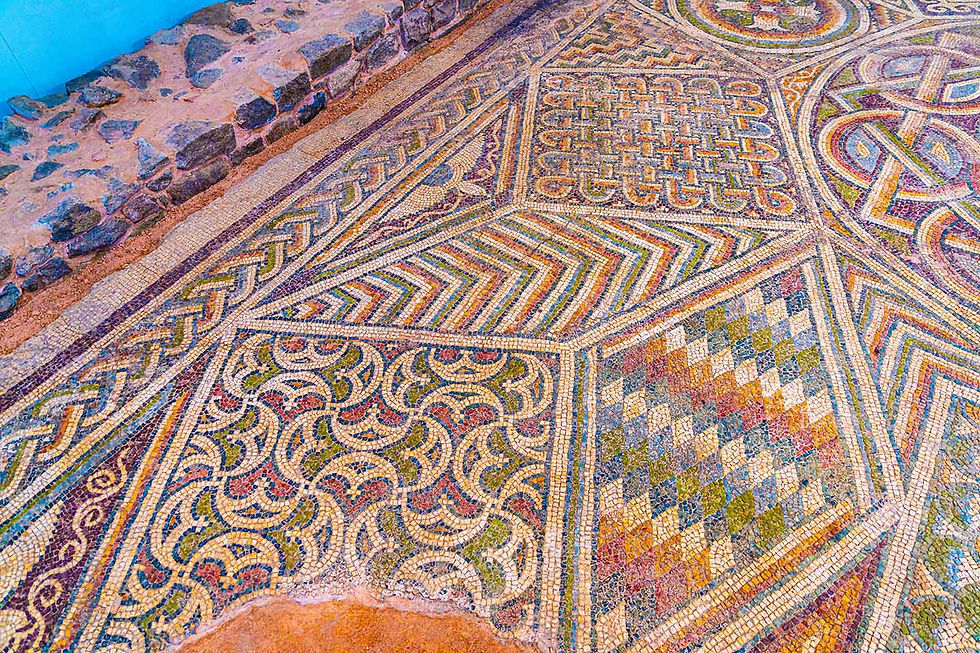
Но не спирайте дотук! Само на няколко минути път се намира "Малката базилика на Филипопол", която е идеалното допълнение към пътешествието ви из Античен Пловдив. Нейните тайни си струват всяка минута!

И за да завършите пътешествието си в античния лукс, продължете към Късноантична сграда "Ейрене" (Ирини)! Разположена насред днешния подлез "Археологически", тя е била една от най-богатите на мозайки частни резиденции в Източните Балкани. Потопете се в разкоша на римския Филипопол!

Пригответе сетивата си за празник – за аромата на смокини и старо дърво, за шепота на вековните камъни, за ярките цветове на Възрожденските къщи и за ритмичния пулс на един град, който живее в хармония между древността и модерното съвремие!

Пловдив едновременно ще ви омагьоса, ще ви развълнува, ще ви вдъхнови и ще ви накара да се влюбите!

Are you ready to immerse yourself in this fabulous reality?
And finally, my dear friends,
you should not miss to check out
the special photo album with moments –
discovered, experienced, filmed and shared with you!


Comments