
Episcopal Basilica of Philippopolis – the largest early Christian church in the Bulgarian lands

When the Stone Speaks
Let me take you on a journey like no other!
Not just to another ancient site from Antiquity, but to a kind of portal in time, where history springs from every corner, and beauty is embroidered on lush picturesque mosaics, which have overcome millennia and reached us.
Close your eyes for just a moment!
Imagine the following: the grandeur of the Roman Empire and the rhythmic pulse of one of the largest cities in the province of Thrace – Philippopolis.

Here, in the heart of this ancient world, a building rose, the foundations of which were laid not simply on stone, but on faith and hope for salvation.
According to legend, Christianity reached Philippopolis as early as the 1st century, turning the city into one of the earliest centers of religion in Europe.
Specific tombstones more categorically date the existence of a Christian community in Philippopolis to around the 3rd century. One of them even preserves the earliest known Christian inscription from the Bulgarian lands. Since Christians were then severely persecuted, the name of our Savior Lord Jesus Christ was denoted by the letters NZN, which meant
Ναζαρηνός – Nazarene
In those times, Christians refused to honor the cult of the divine emperor, which is why they were persecuted, imprisoned, tortured and even killed.
After the legalization of Christianity in 313, Philippopolis became the seat of a bishop. For the growing number of believers, the Episcopal Basilica was built, and nearby the Minor Basilica.
The Episcopal Basilica of Philippopolis The Minor Basilica of Philippopolis
In a series of posts, I will tell you everything about both sites, and this journey is dedicated exclusively to the Episcopal Basilica of Philippopolis, also known as the Great Basilica.
This is not just another archaeological find! This is the Episcopal Basilica of Philippopolis – a cathedral that, with the impressiveness of its size and the splendor of its interior, rivaled the largest sanctuaries in the Eastern Roman Empire!
And now it is before us!
As you step towards it, feel how the ground beneath your feet preserves the memory of the footsteps of thousands of people – emperors, bishops, pilgrims.
This post is my invitation to you to turn the pages of time and immerse yourself in the greatness that Bulgaria has preserved in the very heart of Plovdiv. Because the Basilica is not just the past – it is an inspiration for the present, connecting eras.
Are you ready to cross this threshold?
Then, welcome to Roman Philippopolis!
Welcome to the Episcopal Basilica of Philippopolis Museum Complex!
The stories this place whispers
Archaeologists are uncovering the rich, multi-layered history of continuity and change of this site from the Roman era through Late Antiquity and Early Christianity to the dark years of the Middle Ages.
The foundations of buildings, inscriptions on stone, painted mosaics and grave finds reveal how, over the centuries and eras, people built and transformed this terrain from a place of faith through a modest medieval residential district and cemetery to its complete abandonment and sinking into oblivion.
Over the centuries, the community that inhabited the lands near the hills gathered here to build buildings and create art, to seek God, to prepare food and raise their children, to commemorate events and to bury their loved ones.
But the years roll by, the centuries fly by, entire eras pass by.
After the 15th century, a thick layer of earth gradually accumulated over the area of the Basilica. During these centuries, not a trace of the Basilica is visible, and all its ruins are deep underground.

With the rapid development of technology in the 19th and 20th centuries, Plovdiv grew rapidly.
A lively street appeared next to the abandoned, hidden underground and completely forgotten Basilica. For decades, cars traveled over the northern nave, while their passengers had no idea of the rich history hidden below.

In the early 1980s, a surprising discovery was made!
After centuries of oblivion, today the site of the former Episcopal Basilica is once again full of life as an ultra-modern museum complex dedicated to the study, restoration and exhibition of the site and its extraordinary history. Future generations, citizens and guests of Plovdiv are more than welcome here to discover the variety of stories and unsolved secrets that this place hides.
A harbinger of today's Plovdiv
The Episcopal Basilica of Philippopolis, the harbinger of today's Plovdiv, is an extremely important monument that sheds light on the earliest stages of the institutionalization of Christianity in the Roman Empire.

The Christian community in Philippopolis is deeply rooted, with its history tracing back to the 1st century, associated with the apostle Saint Hermas, who is revered as the city's first bishop.

This early appearance of Christianity in Thrace is supported by evidence of resilience during persecutions, including the martyrdom of Saint Theodota in the 2nd century (under Emperor Hadrian) and the execution of the 37 holy martyrs in the early 4th century, under the reign of Diocletian.
At this place, during the great persecutions against Christians under Emperor Diocletian in the year 304, 37 Plovdiv Christians, holy martyrs for the faith, were killed.
This memorial stone plaque is placed on the wall of the high stone walls of the church "St. St. Constantine and Helena" in the direction of the impressive and silent Hissar Kapiya gate - the charismatic door to the heart of Plovdiv, guarding millennial stories, and its bright and recognizable symbol
This deep historical and spiritual endurance proves the presence of a large and influential Christian group in the city even before the legalization of the faith.

During early Christianity, this open-air courtyard, called the atrium, located in front of the Episcopal Basilica, was full of life.

The community gathered here before mass to meet friends under the colonnades, to ritually wash themselves with water from the fountain, and to await the arrival of priests and dignitaries.

In this place, Christians prepared themselves physically and spiritually to enter the church for liturgy.

As you can see, the architecture of the open courtyard emphasizes its significance.
The marble colonnades and the formal entrance (propylaea) that connected the church to the city showed every passerby that this was one of the most important places in the community.
If we could travel back in time to this exact place, about 1,500 years ago, we would probably hear the constant murmur of water flowing into the fountain from an elegant stone bowl shaped like a shell – a phial.

The churchyards of early Christian basilicas often had such a fountain, due to the special significance of water for Christians, associated with the baptism of our Savior Lord Jesus Christ in the waters of the Jordan River by John the Baptist.
The 4th-century historian Eusebius describes a similar fountain in the early Christian church in Tyre, modern Lebanon:
Here he placed the signs of sacred purification by building fountains directly opposite the church; they overflowed with water and provided purification for those proceeding to the sacred space.
Chronology of construction and connection with imperial decrees
The basilica was actively functioning from the middle of the 4th century to the end of the 6th century.

Its dating is of scholarly interest, as a coin dating from the time of Emperor Licinius (308–324) discovered during excavations fuels the hypothesis that its construction began immediately after the Edict of Milan* of 313, which legalized Christianity in the empire.
*The Edict of Milan or Edict of Milan (Latin: Edictum Mediolanense) was an edict by the two Augusti Licinius and Constantine, issued in 313 in the city of Mediolanum (now Milan), proclaiming Christianity equal to other religions. The edict is traditionally considered to have ended the Diocletianic persecutions against Christians.
If this hypothesis is correct, the Basilica of Philippopolis is among the first monumental Christian temples erected in the Roman Empire, predating many of the Great Basilicas of Constantine.

The monumental size of the building, whose length is 83 meters and width is 36 meters, and its central positioning near the Ancient City Forum of Philippopolis represent a conscious public act of institutionalizing Christian authority.

This scale, especially in the years following legalization, was a show of force aimed at transforming the symbolic center of Philippopolis, which had previously belonged to the imperial administration and pagan cults.

The construction of such a colossal site, including 2,000 square meters of lavish mosaics, took enormous financial and logistical resources in the mid-4th century.

This clearly demonstrates that Philippopolis was a city with exceptional economic power and high social stability during Late Antiquity, allowing the financing of these state-like projects by the local church authorities.

Perhaps this is the place to remind you that the Roman Empire almost perished during the Crisis of the Third Century.
The Emperors Who Revived Philippopolis
Emperors changed frequently, constant civil uprisings shook the fragile state, barbarian attacks did not stop even for a moment. This fate did not pass Philippopolis by. In 250-251, the Goths devastated the city, leaving behind burned remains and thousands of dead.
But Philippopolis soon rose from the ashes thanks to the emperors Valerian and Gallienus. The inhabitants of the city honored their help with a stone inscription from 253-254, which reads:
Good luck!
To the victory, health and eternal existence of the emperors Publius Licinius Valerianus and Publius Licinius Gallienus Augustus and their entire household, of the sacred Senate and the Roman people, and of the Council and the people of Philippopolis!
After the death of the emperors, their political enemies erased their names, which was a common practice in the Roman Empire at that time. At the end of the 4th century, Christian builders used the inscription for the pavement of the atrium of the Basilica. They laid it face down and thus quite unknowingly preserved the long and detailed text that reaches us 1,600 years later.

When the inscription was discovered in 2019, the epigraphs read the names of the emperors, which reinforces the hypothesis that the Episcopal Basilica was built on the foundations of a temple and administrative buildings associated with the cult of the emperor.
That is why the first steps we take today in the midst of the deeply impressive museum complex "Episcopal Basilica of Philippopolis" are precisely on stones that do not belong to the Episcopal Basilica itself, but to an earlier pagan building from the 2nd century - 4th century, which already existed at this location.

It was at this very spot that a fragment of a building inscription was discovered, which reads:
To the health and well-being of the emperor...
Reading the inscription, due to the shape of the letters, which changed over time in Antiquity, the epigraphers came to the conclusion that the emperor in question was precisely Septimius Severus, who ruled from 193 to 211 AD.

The early Christian community felt the need for a huge church, which is why the builders went beyond the outlines of the destroyed pagan building, with the southern and northern stylobates (column bases) of the temple of the deified emperor remaining under the side aisles of the new basilica.
It is clear that the Episcopal Basilica was built on the foundations of a temple of the imperial cult. But what did it look like? And what is its connection to the oval structure that we see before us today, standing at the beginning of the grandiose museum complex?
The mysterious pool
During the excavations of the oval structure, archaeologists did not find any artifacts - something typical of public buildings of the era. But its architecture still provides some clues. Oriented in an east-west direction, the structure is 14 meters long and 6.5 meters wide and was part of the temple. The hydrophobic plaster on its inner walls and bottom suggests that the structure probably served the functions of a decorative pool. What it was used for remains a real mystery.

When the Christians began construction of the Basilica, they filled in the oval structure and laid the first layer of mosaics on top. The mysterious pool remained hidden for centuries before archaeologists discovered and studied it.
Architectural Morphology, Chronology and Episcopal Purpose (4th – 6th centuries)
The Episcopal Basilica of Philippopolis is the largest early Christian temple in present-day Bulgarian lands and one of the most impressive in the entire Balkan region for the period 4th – 6th centuries.

Its length of 83 meters and width of 36 meters make it comparable to the largest church structures in the Eastern Roman Empire.
Architectural layout and interior
The building was designed as a three-nave, single-apse basilica, complete with a narthex (cloister) and a vast colonnaded atrium (inner courtyard).

In its heyday, the interior was remarkable!

The central nave contained a marble-decorated presbytery – a platform intended for the bishop and the clergy.

The presence of a raised and decorated presbytery, compared to more ordinary churches, demonstrates the high hierarchical position of the bishop and the institutional structure of Philippopolis as a metropolitan center.

The basilica functioned as the official administrative and liturgical center of the entire diocese, where mass baptisms of adults and children were performed.

The interior of the temple was further decorated with columns whose capitals bore Christian symbols, as well as with frescoes and, most importantly, with lavish mosaic floors.
Stratigraphy and Evidence for Status
Archaeological studies have established that the Basilica was built on the ruins of an earlier monumental building, probably dating from the 1st century AD.

The site has undergone a multi-phase evolution, functioning through three main periods of flooring laid one on top of the other.

The first floor was filled with pink mortar (opus signinum), its terminus post quem being determined by a discovered coin.

Two layers of mosaics follow, made in a total of three stages. This sequence of three pavements, laid over about 200 years (between the 4th and 6th centuries), suggests not only maintenance but also a continuous economic opportunity for luxurious renovation during the Late Antiquity period.

Each floor renovation is an act of financial and spiritual strength that maintains the prestige of the episcopal see.

The episcopal status of the building is strongly confirmed by the architectural layout and epigraphic evidence. In the first layer of mosaics in the south aisle, a donation inscription was discovered, which explicitly defines the building as episcopal and preserves part of the name of the cleric who probably commissioned or financed the mosaic floor – -kian.
The mystery of the inscription
The construction of a large and richly decorated church like the Episcopal Basilica represented a significant community effort. Therefore, when the south aisle was decorated with mosaics, the event was commemorated with an inscription. Unfortunately, today only the last lines of it are partially preserved:
...made the mosaics when bishop was [...]kian.

It is still a mystery whether the name is Lucian or Marcian, but the inscription is the first evidence of the existence of a bishop of Philippopolis.
As the Church became a powerful institution in the Roman Empire, it was not uncommon for wealthy people of pagan origin with good education and administrative experience to be elected bishops. The mention of the bishop's name may indicate that he personally paid for the mosaics.

In the mosaic, the inscription is shown placed on a low column. An early Christian visitor to the Basilica would have read this as a depiction of an altar table – the place where the priest consecrates bread and wine for Holy Communion.
The inscription is placed on a tabula ansata (table with handles), a popular motif in antiquity, depicted on pagan sarcophagi, amulets and monuments. The jugs at the base of the altar are filled with wine and water.
The Episcopal See and the Theological Disputes – the Role of the Basilica in the 4th Century
In the 4th century, Philippopolis was not simply a regional center of Christianity, but an important participant in the greatest doctrinal controversies of the age.

The city was an active center of Arianism - a doctrine that denied the full divine nature of our Savior, the Lord Jesus Christ, and which was condemned as heresy at the First Ecumenical Council of Nicaea, held in 325 AD.

I tell and show all this in detail in my publication "The Granite Oak, Saint Athanasius, the Council of Serdica and the Defense of the Truth", which you can read HERE.
The large size and magnificent decoration of the Basilica, completed in the middle of the 4th century, coincide with the apogee of the doctrinal disputes and show that an influential Christian faction dominated the city.
The Counter-Council of the Arians in 343
The culmination of the theological clashes was in 343.
Initially, a council was convened in Serdica (present-day Sofia), at which the bishops condemned Arianism. In response, the bishops adhering to the Arian doctrine organized their own counter-council in Philippopolis.

The central episcopal basilica, which was the largest and most imposing building in the city, is the most likely site for this council. Through this event, the Basilica of Philippopolis becomes an important historical witness to the formation and earliest stage of liturgical and doctrinal practices in the Eastern Roman Empire.

The monumental construction, probably financed by an Arian bishop (such as the aforementioned –kian) or sympathetic local elites, was intended to legitimize the Arian faith as official and imperially worthy.

The basilica served as a visible, physical demonstration of the power of the doctrine at a time when it was being declared heretical by its opponents.

The holding of the two councils (one in Serdica, the other in Philippopolis) in close proximity in Thrace emphasizes the strategic and political importance of the region as a kind of theological buffer zone between the East (with its capital in Constantinople) and the West (with its headquarters in Rome and Milan), the results of which directly influenced the administrative and religious map of the empire.

Now let me show you something that has remained hidden for centuries – the original stone walls of the largest early Christian church in the Bulgarian lands.
The Apse of the Basilica
Early Christian basilicas usually have an apse at their eastern end. From the outside, this special niche may have looked different. Some had three or five walls, while others, like the one in the Episcopal Basilica, were semicircular.

From the inside, the apses were similar. They were semicircular niches covered by a hemispherical dome with frescoes or mosaics depicting biblical scenes.

The apse is important in early Christian architecture, but its origins are pagan. In pre-Christian temples, the statue of the venerated deity stood here.
The most sacred part of the Basilica
The altar, the most sacred part of the Basilica, was located here. During the service, the priests gathered on the marble-decorated raised platform (presbytery) that once stood here. They sat on a semicircular bench (sintron), with the bishop occupying a raised throne in the middle.

Now I will show you where the baptistery was located.
Baptistery
The Baptistery is one of the most important rooms in the Basilica – it is the place for baptisms..

This baptismal font was used for the baptism of children. Adults usually entered a small pool (piscina).

The episcopal basilica probably originally had such a pool. In the 5th century it was probably replaced by a font, when children became the majority of those baptized.

In the nearby early Christian Minor Basilica, it is possible to see a perfectly preserved cross-shaped marble basin decorated with mosaics, which was used for the baptism of adults.

But the years go by, the centuries fly by, and time changes all of this.
The Legacy of the Basilica in the Post-Ancient Period and Medieval Bulgaria (7th Century – 14th Century)
The functioning of the Episcopal Basilica ended towards the end of the 6th century.

Its abandonment was a result of the decline of Philippopolis, which occurred as a result of large-scale invasions (Slavic and Avar) in the 6th and 7th centuries, which forced the population to seek safe refuge among the fortified hills, or perhaps it was caused by a devastating earthquake.
Medieval Quarter
When the Episcopal Basilica was abandoned in the 7th century, it did not immediately become a ruin. For several centuries its walls and rooms still stood and were inhabited.

By the 10th century, the ancient church was in ruins and people built modest houses of wood, clay, and stone with thatched roofs on its remains. These medieval homes were probably part of a larger medieval quarter that extended to the site of the ancient Roman forum.

Medieval dwellings were mostly made of perishable materials and had modest furnishings. During excavations, archaeologists have found scant traces of them – stone foundations, hearths with layers of charcoal, and garbage pits dug into ancient mosaics.

The layers of charcoal on the "Source of Life" mosaic are traces of fire. There was probably a medieval hearth here.

Although the monumental building ceased to exist as a functioning temple, the site retained its sacredness. During the Middle Ages, from the 10th to the 12th (to the 13th) centuries, the ruins of the Basilica were occupied by a large Christian necropolis. In the 10th century, the citizens of Philippopolis began to bury their dead on the ruins of the church, turning the site into a cemetery (necropolis).
Medieval necropolis
The earliest graves are located on the northeast corner of the Basilica. They are located lower than the others, because over the centuries the level of the terrain has risen.

The tomb shows that the community continued to use this site long after the Basilica was abandoned.

This change of function from a monumental temple for the living to a cemetery for the dead reflects the religious pragmatism and cultural memory of medieval Christians. Although they lacked the resources to rebuild the large-scale basilica, they used its ruins as a consecrated ground (locus sanctus), ensuring the continued sacredness of the site and a connection to the prestigious early Christian tradition.

A small cemetery church was built over the ruins of the ancient temple, decorated with fine frescoes. Archaeological finds from this period, including cross-shaped pectoral reliquaries and seals, confirm the continued cultic use of the site for burials.

The inhabitants of Philippopolis probably created their necropolis here because they still remembered that the place was sacred. Over the next four centuries, hundreds of men, women and children were buried here, creating the largest medieval necropolis in Plovdiv.
Excavations of the medieval necropolis have uncovered the remains of over 300 people. Archaeologists and anthropologists are carefully documenting and analyzing the bones and belongings of nearly 180 of them in an attempt to better understand who these people were, how they lived, and what place they held in society.
Continuing Sacred Geography
Today, the Basilica of Philippopolis continues to have a central spiritual significance in modern Plovdiv. It is located in close proximity to the central city square, and in its place in the 19th century, the Catholic Cathedral of St. Ludwig was built.

This historical continuity is an example of the transmission of spiritual ideas and the importance of the place through different eras.
Museum Complex "Episcopal Basilica of Philippopolis" - Conservation, Restoration and Exhibition Strategy
The history of the modern study of the Episcopal Basilica begins with rescue archaeological excavations in the mid-1980s, when the remains of the southern and central nave, the apse and part of the atrium were discovered. Due to scarce funding during this period, some of the mosaics were dismantled and moved to the Archaeological Museum - Plovdiv.

This initial measure, although contrary to the modern in situ principle, testifies to their exceptional scientific and artistic value, recognized by archaeologists even with limited resources.
Large-scale restoration project and financing
A large-scale restoration and conservation project was launched in 2014, transforming the ruins into an ultra-modern museum complex, completed in the period 2020 - 2021. The total investment exceeds 15 million leva, provided through a public-private partnership between the Municipality of Plovdiv, the America for Bulgaria Foundation and the Ministry of Culture of the Republic of Bulgaria.

The completion of the complex is a key initiative related to Plovdiv’s status as European Capital of Culture in 2019, drawing global attention to this unique historical site. The site is also included in Bulgaria’s Tentative List of UNESCO World Heritage Sites.
Architectural Concept and Conservation Technologies
The modern architecture of the protective covering follows the principle of differentiation from the original, using contemporary means of expression. The structure is designed with the highest conservation standards.

The long facades are made of a beam-type construction, which frees the exhibition space from structural elements, while the external facade of double U-glass, combined with thermal insulation wool, provides effective thermal insulation and, most importantly, evenly filters natural light, protecting the sensitive mosaics from UV radiation and glare.

The technical specifications of the lighting are directly subordinated to the conservation requirements. Energy-saving LED light sources with a high color rendering index in warm white light are used, with individual control of each lighting fixture. This guarantees the longevity of the mosaics through a controlled environment, while preserving the aesthetic perception of the ancient colors.
Innovative two-story exhibition
The ultra-modern museum complex applies an innovative exhibition strategy that solves the problem of stratigraphy and the early dismantling of some of the mosaics, presenting them on two levels:
Ground / semi-underground level (in situ)
The original archaeological level exhibits the mosaics from the first and second construction periods in situ.

Visitors move along a glass walkway elevated above the mosaics, allowing observation without direct physical contact, while interference with the archaeological areas is minimized.

2. Second Level (Restored)
Access to the second floor is via a spiral ramp, the shape of which repeats the apse.
Here are exhibited the preserved and restored parts of the mosaics of the second layer, which were dismantled in the 1980s.
On this floor, a super interesting and fun interactive exhibition for children has also been organized, incorporating AR/VR technologies to tell the history of the site in an attractive way for a modern audience.
A cultural catalyst for urban development
The project goes beyond conservation! It includes a complete transformation of the central square space (about 8,000 sq m), which is a catalyst for a complete urban regeneration. The urban space has been transformed, giving priority to pedestrian traffic over car traffic, in order to create a wide public space integrated into the pedestrian network of the city. Belvedere, children's corners and green buffer zones have been created, and access to the Basilica is provided by an urban elevator.
The unique contribution of the Basilica of Philippopolis to the European Christian Heritage
The Episcopal Basilica of Philippopolis is a monumental historical site that occupies a central place in the history of early Christianity in Europe. Its exceptional architectural monumentality, its dating immediately after the Edict of Milan, and its role as the probable scene of the Arian Counter-Council of 343 position it as a key witness to the theological and political struggles that shaped the Late Roman Empire. Its scale and luxury testify to the exceptional economic power and spiritual resilience of the See of Philippopolis in the 4th–6th centuries.

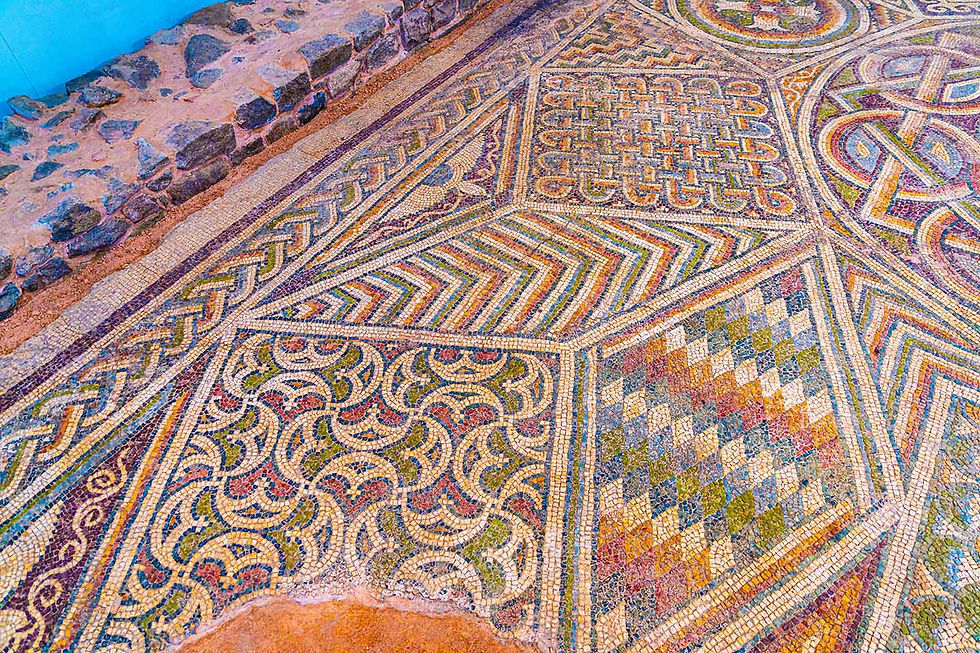
Its most valuable contribution remains the floor mosaics – the largest preserved in situ ensemble on the continent, covering a total area of 2,000 square meters. These two layers of mosaics document not only the artistic transition from abstract symbolism to a figurative depiction of the Garden of Eden, but also the shift in church communication towards more direct theological preaching.

What do the mosaics from the museum complex "Episcopal Basilica of Philippopolis" - the largest and best-preserved mosaic ensemble from Early Christianity in Europe - tell HERE.
The transformation of the site into an ultra-modern cultural center, carried out through innovative architecture and significant public-private funding, is a model for heritage preservation.
By integrating the two-story exhibition, glass walkways and modern technologies, the long-term protection of the mosaics is guaranteed, while preserving the historical continuity of the site.
Today, the Basilica serves not only as a museum, but also as a catalyst for the overall urban regeneration of Plovdiv.
In 2018, the Episcopal Basilica and the Late Antique Mosaics of Philippopolis, Roman province of Thrace, were declared an archaeological monument of culture with the category of national importance.
The Episcopal Basilica of Philippopolis Museum Complex is site number 41b of the One Hundred National Tourist Sites of Bulgaria.
How to get to the city of Plovdiv?
Imagine a city that has seen thousands of golden sunrises and fiery sunsets, that has been a constant witness to the triumphant rise and inevitable and tragic fall of empires, and that today stands confidently, unwaveringly and majestically, telling its thousand-year history!

Welcome to Plovdiv – one of the most ancient cities in Europe!

Plovdiv is one of the best European tourist destinations!

Plovdiv is one of the best destinations for cultural tourism in Europe!

Brave travelers, get ready!
We will head to an extraordinary place where history is not just a series of dates, but if you reach out, you will touch it!

A place so old that it was born before legends, and so beautiful that it will steal your sleep!

When you step onto the smoothed cobblestones of the narrow winding streets of the Old Town, you can't help but feel the quiet and ancient breath of the past!

Every stone here, every house with carved facades, every hidden alley bears the imprint of Thracians, Romans, Byzantines, Bulgarians and Ottomans.

Plovdiv is not just another tourist destination!

Plovdiv is an experience like no other!

Plovdiv is a place where you can drink your morning coffee in a square where Roman legions once marched!

Plovdiv is a place where you can get lost among the Ancient Theater, which was a stage for gladiatorial battles and dramatic plays!

Plovdiv is a place where you can admire the purple sunset from Nebet Tepe – the hill where it all began millennia ago!

We will explore the impressive and silent Hissar Kapiya gate – the charismatic door to the heart of Plovdiv, guarding thousands of years of history, and its bright and recognizable symbol.

In Plovdiv we will pass through the Archaeological Complex of the Eastern Gate of Philippopolis - the most important and most used gate of the ancient city, as it was the main connection between it and Byzantium (the future Constantinople).

Plovdiv is a place where the museum complex "The Episcopal Basilica of Philippopolis" awaits you - a monumental cathedral, which with the impressiveness of its size and the splendor of its interior rivaled the largest sanctuaries in the Eastern Roman Empire!
Here, a huge canvas woven from millions of colorful tesserae has been painstakingly and carefully arranged – an endless carpet of indescribably beautiful mosaics!
But don't stop there! Just a few minutes away is the "Small Basilica of Philippopolis", which is the perfect addition to your journey through Ancient Plovdiv. Its secrets are worth every minute!

And to complete your journey into ancient luxury, continue to the Late Antique Building "Eyrene" (Irini)! Located in the middle of today's "Archaeological" underpass, it was one of the richest mosaic-covered private residences in the Eastern Balkans. Immerse yourself in the splendor of Roman Philippopolis!

Prepare your senses for a celebration - for the aroma of figs and old wood, for the whisper of centuries-old stones, for the bright colors of the Revival houses, and for the rhythmic pulse of a city that lives in harmony between antiquity and modernity!

Plovdiv will simultaneously enchant you, excite you, inspire you and make you fall in love!

Are you ready to immerse yourself in this fabulous reality?
Plovdiv is located:
161 kilometers (about 2 hours and 6 minutes by car) from the capital
376 kilometers (about 4 hours and 14 minutes by car) from the city of Varna
254 kilometers (about 2 hours and 24 minutes by car) from the city of Burgas
How to get to the museum complex "Episcopal Basilica of Philippopolis"?
The museum complex "Episcopal Basilica of Philippopolis" is located at 2, Princess Maria Luisa Blvd.
Dear friends, before I show you what interesting sights you can see nearby, I would like to remind you of the special photo album, which has collected incredible beauty and impressive photo moments just for you, a link to which you will find at the end of the post!
Enjoy it!
And finally, my dear friends,
you shouldn't miss to check out
the special album with photo moments –
discovered, experienced, filmed and shared with youс!

Comments