
The completely renovated tourist trail to the monument in the Oborishte Historical Site, part of the "Freedom Alley"

Updated: May 27
This publication concerns the completely renovated tourist trail leading to the monument in the Oborishte Historical Site, which is part of the "Freedom Alley" trail.

The next button is a link to my publication "Freedom Alley Trail Connecting the Town of Panagyurishte and the Oborishte Historical Site":
Tourist trail to the monument in the Oborishte Historical Site
Location
The Oborishte Historical Site is located in Sashtinska Sredna Gora, on the territory of the Panagyurishte municipality.

The tourist trail starts from a separate parking lot, located about 8 kilometers west of the town of Panagyurishte.

This extensive parking lot can be reached in several ways - on foot along "Freedom Alley", by bicycle along "Freedom Alley" and by car.
Numerous wooden benches have been newly built near the parking lot.

Route characteristics
Type of route – entirely pedestrian, linear.
Length – about 1.3 kilometers in one direction (total about 2.6 kilometers for the entire route out and back).
Terrain – the trail has a small elevation gain, classified as easy and suitable for people of different physical fitness, including families with children. The route passes through a centuries-old beech forest.
Hydrography – the route follows the natural curves of the Panova River valley. Along the trail, a number of wooden bridges have been completely newly built, ensuring safe crossing over the riverbed. In places, the trail borders steep slopes towards the river, which are secured by newly built wooden railings.
Duration – the hike takes about 60 minutes (total in both directions), depending on the pace and the number of breaks.
Facilities – a large parking lot has been built at the beginning of the route. A number of wooden benches for relaxation have been newly built in the area of the monument and the parking lot.
Site Status
The area has the status of a protected area with an area of 203.8 hectares and is part of the list of 100 national tourist sites (under number 36).

The end point of the trail is the monument in the Oborishte Historical Site, erected in 1928 according to a design by the sculptor Yanko Pavlov.
The completely renovated tourist trail
On the occasion of the 150th anniversary of the April Epic, the original trail, built in 1976, connecting the town of Panagyurishte and the Oborishte Historical Site, has been completely renovated on the initiative of the donor "Asarel-Medet" AD.

Newly built safety wooden railings have been installed almost along the entire length.
The pavement of the trail itself is also new and all the bridges over the Panova River are completely newly built.
At this point the main trail branches.

The fork to the left leads to the end point along the western (steep) bank of the Panova River.

The fork on the right also leads to the end point, but along the left bank of the Panova River, descending smoothly towards the river bed.

As you can see, both forks of the trail lead to the end point, so which direction you choose is a matter of preference. You can always return to the starting point along the other (untraveled) part of the trail.
I took the right fork, which descends gently to the river and winds along it.
Before you cross the last newly built wooden bridge, look to the left.
150 years of the April Uprising – BTU

On April 18, 2026, at this point above the river on the rock, the Bulgarian Tourist Union placed a commemorative plaque "150 years of the April Uprising - eternal memory".

At the end point of the tourist trail - in the area around the monument - a row of newly built wooden benches have been built.
Faith, will and steel.
Three symbols carved in wood that say it all...

Right here, under the sacred shadows of Oborishte, this new woodcarving takes us back to the moment of the great oath.
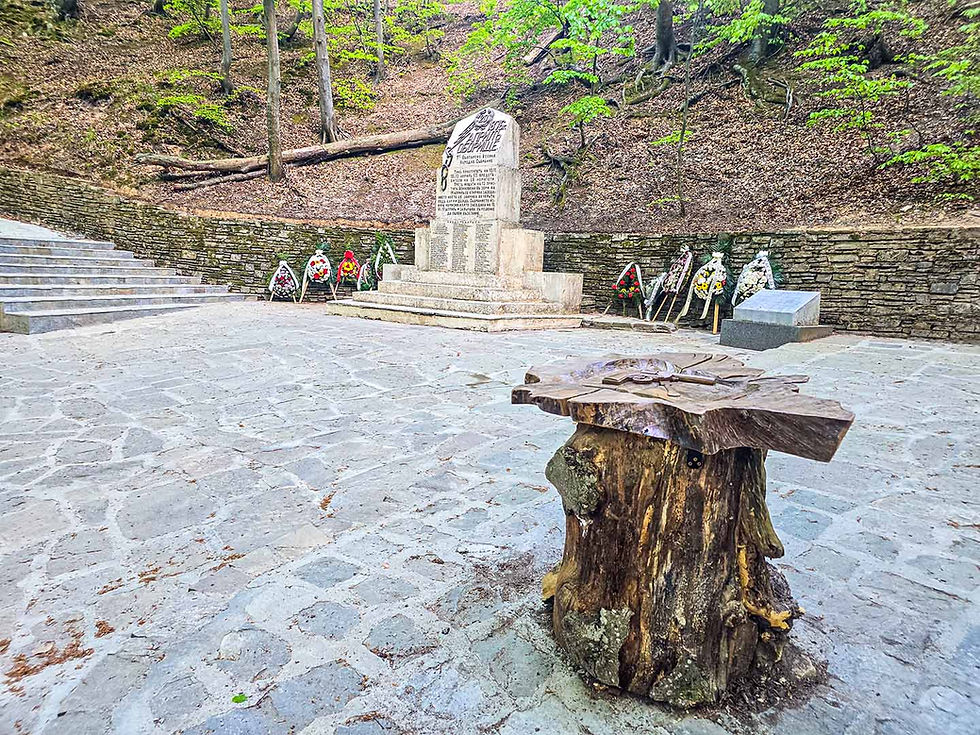

This is where the story of Bulgaria's freedom begins.

I captured these details for you so you can feel the spirit of the place where this dream was born.
The woodcarving was made on order of "Asarel-Medet" AD by the Panagyurishte master woodcarver Marin Kushlov, a history and geography teacher at the "Nesho Bonchev" Secondary School in the town of Panagyurishte.
Forest first aid kit
A new forest first aid kit has been placed near the benches near the monument.
I chose to return to the starting point via the upper of the two paths.
Messages through the ages
All the tablets with messages whispering through the ages shine renewed. I filmed them for you! I will present them to you in chronological order from the beginning to the end of the path.

The first quote that greets travelers on the trail is:
The people of Panagyurishte immortalized the name of their modest town. Their Oborishte and their town should hold first place in the pages of modern Bulgarian history.
It belongs to the chronicler Zahari Stoyanov and emphasizes the key role of the town in the April Uprising of 1876. According to him, because of Oborishte and the heroic actions, Panagyurishte should hold first place in modern Bulgarian history.

Dimitar Blagoev, as the founder of the organized socialist movement in Bulgaria, gives due credit to the national feat and revolutionary spirit of the Bulgarians, who turned April 20 into a symbol of national dignity.
April 20 is a peak in our history, which eloquently speaks of the height of the fighting, freedom-loving and revolutionary character of our people.
This thought of Dimitar Blagoev emphasizes the exceptional significance of April 20, 1876 – the beginning of the April Uprising.
The third message, welcoming travelers along the path, emphasizes the idea of self-sacrifice and personal responsibility in the struggle for liberation. The full meaning of the phrase is:
Let no one think that freedom is gained without blood and without a precious sacrifice!
Let no one wait for someone else to free him.
Our freedom depends on us!
The quote is by the ideologist of the Bulgarian national liberation movement Georgi Rakovski from his "Call to the Bulgarians for Uprising".
The following is a quote that is often used as a symbol of national self-confidence and a sharp rise in critical moments.
And in a few days, secretly and slowly, the people grew several centuries old!
These are emblematic verses from the ode "Kableshkov" by Ivan Vazov, part of the cycle "Epic of the Forgotten" from 1881. With them, the poet describes the lightning-fast spiritual and psychological awakening of the Bulgarian people during the April Uprising, which in a matter of days overcame the centuries-old servile timelessness and grew to heroism.
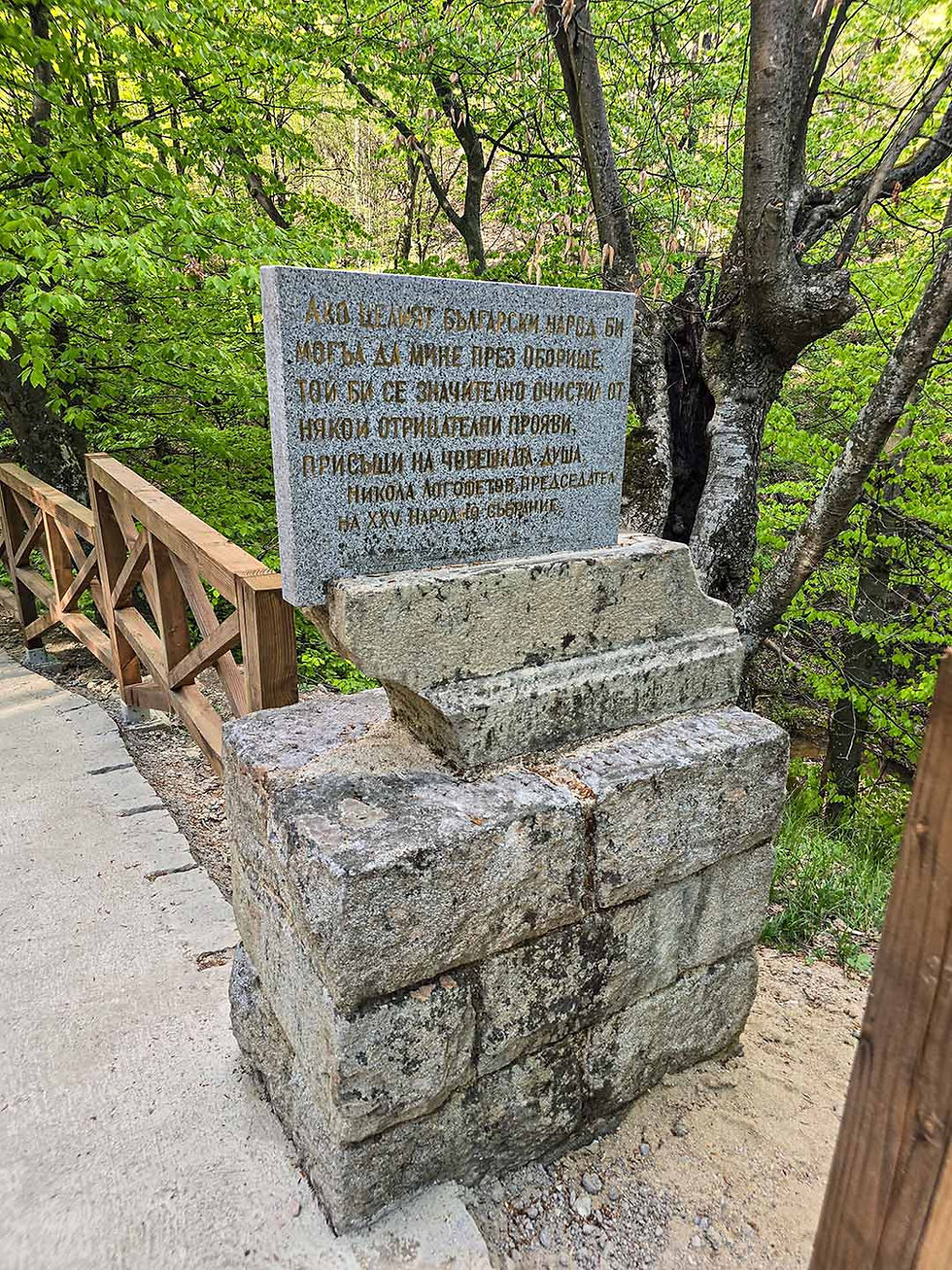
The next message on the trail is the phrase:
If the entire Bulgarian people could pass through Oborishte, they would be significantly cleansed of some negative manifestations inherent in the human soul.
This emblematic quote, attributed to the Bulgarian politician and public figure Nikola Logofetov, emphasizes the enormous moral and historical significance of the Oborishte area, in the midst of which we are walking together, you and I, now.
To be equal with other European nations depends on our own joint efforts!
The next message welcoming us on the path is a famous testament of Vasil Levski from a letter to newly admitted members of a revolutionary committee (dated February 19, 1872). With these words, the Deacon calls for independence, unity and responsibility in order to build a "Holy and Pure Republic".
This call has been noted as an eternal goal for national self-confidence and modern development.

These emblematic words were uttered by Georgi Benkovski, one of the main apostles of the April Uprising in 1876. According to the chronicler Zahari Stoyanov, Benkovski said:
My goal has already been achieved!
In the heart of the tyrant I have opened such a bitter wound that it will never heal, and let Russia command!
The phrase symbolizes that even in the event of military failure, the goal of the uprising has been achieved – to show the world the cruelty of the Ottoman rule and to provoke the intervention of the Great Powers.

There is no power over that head that is ready to separate itself from its shoulders in the name of freedom and for the good of all humanity!
These words belong to the great Bulgarian poet and revolutionary Hristo Botev. They express his philosophy of inner freedom – a person who has overcome the fear of death in the name of a higher ideal becomes untouchable for any earthly tyranny and oppression.

There is no people more suitable for a republic than ours!
This thought belongs to Georgi Benkovski, one of the main leaders of the April Uprising of 1876.
According to historical information and the memories of contemporaries, he uttered these words (in various variations) to emphasize the democratic spirit of the Bulgarian people and their ability for self-government. Studies of his propaganda and agitation activities note that Benkovski believed in the following:
Readiness for freedom: the Bulgarian people are naturally inclined towards republican rule because of the way in which Bulgarian municipalities and villages are organized.
Natural order: he argues that if foreign (Turkish) power is removed, the republic is ready, since it already exists in small local communities.
Contrast: this vision is often contrasted with more critical assessments of the people in Bulgarian literature, such as the famous poem by P. R. Slaveykov "We Are Not a People".
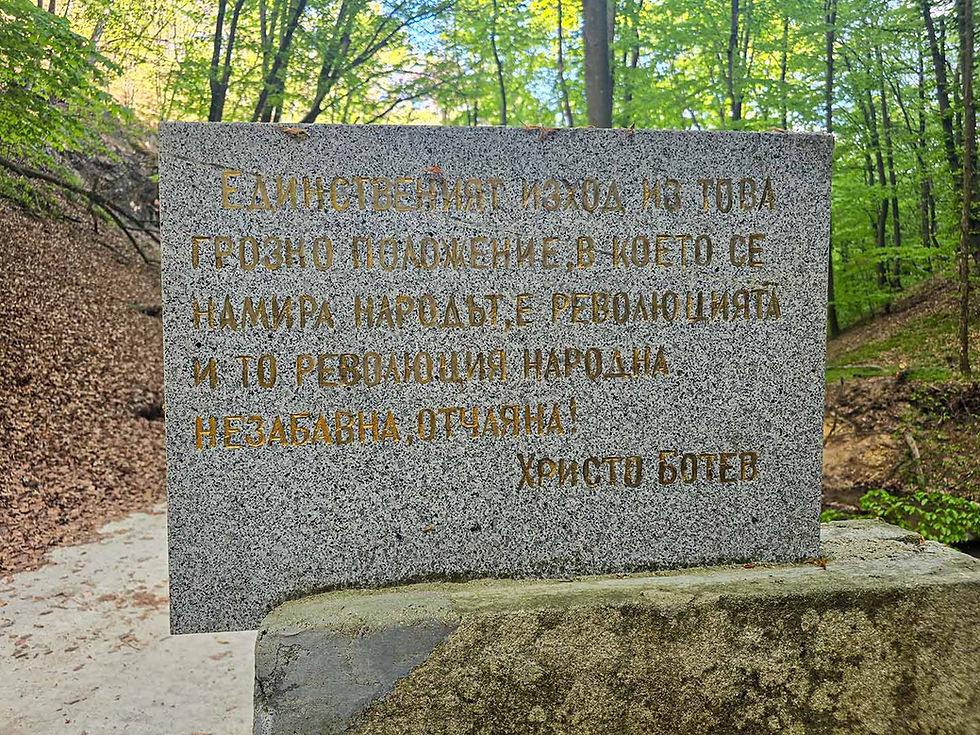
The only way out of this terrible situation in which the people find themselves is revolution, and a people's revolution, immediate, desperate!
This is an emblematic quote from the journalism of the great Bulgarian poet and revolutionary Hristo Botev.
In a historical context, Botev wrote these words during the period of the national liberation struggles in the 19th century, referring to the complete lack of freedom, the difficult political and economic situation of the Bulgarians under Ottoman rule, and the need for radical change through organized struggle.

The following is one of the strongest appeals in Bulgarian history, related to the April Uprising of 1876.
The full quote is:
Oh, Bulgarian!
Prove that you too live, show how you know how to appreciate precious freedom!
This appeal is part of the apostles' appeal (often attributed to Georgi Benkovski) to the people, calling for uprising, self-sacrifice and dignity. This phrase is a symbol of the Bulgarian aspiration for freedom and courage, left in history by the Panagyurishte rebels.

My Oborishte deputies are angels, the purest ideal personalities among the people, the only rewards – I mean, expulsion and daily allowances – for which were the ugly gallows and the Zaptyan whip.
This moving phrase belongs to Zahari Stoyanov. With it, the chronicler of the April Uprising describes the delegates of the First Bulgarian National Assembly in the Oborishte area in 1876. The full quote emphasizes their idealism and self-sacrifice.

We do not want wealth,
we do not want money,
but we want freedom,
human rights!
"We do not want wealth" is one of the most emblematic Bulgarian revolutionary songs, the lyrics of which were written by Stefan Stambolov. It was written in 1875 and quickly became a march and unofficial anthem of the national liberation movement. The song expresses the complete dedication to the struggle, placing freedom and human rights above material goods.

Oborishte! In a bright wreath of names,
a wreath, Bulgaria that adorns and will adorn to the end
— the brilliance, from you that shines,
there it and only it gives greatness.
Without you, world oblivion would quickly
devalue them – like a pearl necklace
who lacks the Yalmaz, unforged
good and somewhere lost…
This ecstatic excerpt from the poem "Oborishte", part of "Bloody Song" by Pencho Slaveykov, glorifies the historical meeting of 1876. The place is presented as a center, bestowing greatness and national self-confidence.
This is also the last message on the path, reaching us through the centuries.
The Benches – the Final Touch
In mid-May 2026, a large number of wooden benches were installed along the entire length of the trail, now offering weary travelers a safe rest under the dense beech shadows and by the noisy waters of the Panova River.
How to get to the Oborishte Historical Site by car?
At the junction of the Republican Road III-801 Vakarel - Panagyurishte there is a signpost for the site with the inscription "Oborishte", the distance to the destination is also written - 3 kilometers.

At the fork between the two roads, a monument has been erected, representing a stylized lion, beneath which are crossed swords and a revolver.

If you are traveling from Panagyurishte to Vakarel, the turnoff is on the right.
Oborishte Historical Site is located:
100 kilometers (about 1 hour and 30 minutes by car) from the capital
83 kilometers (about 1 hour and 20 minutes by car) from the city of Plovdiv
437 kilometers (about 5 hours by car) from the city of Varna
322 kilometers (about 3 hours and 10 minutes by car) from the city of Burgas
8 kilometers (about 11 minutes by car) from the city of Panagyurishte
How do I get to the starting point of the "Freedom Alley" trail?
The starting (starting) point of the "Freedom Alley" trail is located at the westernmost point of the city (the roundabout itself - the westernmost point of Pyatigorsk Blvd.).
For all guests of the city who would like to start their adventure from here, I advise you to leave your cars either in the parking lot of the large grocery store nearby, or along the ring road starting south of the gas station. Unfortunately, there is no parking lot in this area.
How to get to the city of Panagyurishte?
Panagyurishte is located:
94 kilometers (about 1 hour and 42 minutes by car) from the capital
80 kilometers (about 1 hour and 11 minutes by car) from the city of Plovdiv
421 kilometers (about 4 hours and 49 minutes by car) from the city of Varna
314 kilometers (about 1 hour and 2 minutes by car) from the city of Burgas
What can you visit in Panagyurishte?
Panagyurishte is a town in Central Bulgaria, the administrative center of Panagyurishte Municipality, Pazardzhik District.

Панагюрище се намира в планински район – Същинска Средна гора, на 43 километра (на около 40 минути с автомобил) северно от областния град.

Панагюрище е административен център на община Панагюрище, в състава на която влизат още девет селища. Съседни населени места са: курортното селище Панагюрски колонии (отстои на около 15 километра на север), село Оборище (отстои на около 10 километра на запад), село Баня (отстои на 11 километра южно), село Бъта (отстои на около 8 километра на юг) и град Стрелча (отстои на около 12 километра на изток).

В землището на град Панагюрище се намира и селище Панагюрски колонии, което няма собствено землище.

На север от него, близо до курортното селище Панагюрски колонии, се издига връх Братия (1519 метра н.в.).

През града тече река Панагюрска Луда Яна, която след село Попинци се съединява с река Стрелчанска Луда Яна, като по този начин се образува река Луда Яна.
Гара "Панагюрище" е последната гара по ЖП линията "Пловдив – Панагюрище".

Борбено Панагюрище е един прекрасен български град, който предлага на своите гости чудни места за посещение.
Не бива да пропускате да разгледате невероятно интересната експозиция на Исторически музей Панагюрище, посветена на Априлското въстание, с оригинални реликви, свързани с героичната епопея от април 1876 г.
Дудековата къща, част от музейния комплекс, е архитектурно-историческа забележителност в Панагюрище от епохата на Възраждането. В нея е подредена етнографско-историческа експозиция, отразяваща възрожденския бит и култура.

В околностите на града съществуват десетки тракийски могили.

В една от тях – могила "Мрамор" е разкрито погребение на тракийски вожд.

Недалеч от нея през 1949 г. е открито световноизвестното Панагюрско златно съкровище, датирано от периода IV-ти – III-ти век преди Христа.

Съкровището е намерено случайно от тримата братя тухлари Павел, Петко и Михаил Дейкови, докато копаели земята за глина. Изработено е от чисто злато и тежи 6,164 килограма.

Копия на деветте уникални златни съда са постоянно изложени в историческия музей в града, а оригиналите обикалят музеите из България и по света.
20 априлий лето 1876-то!
Бунт!
Въстание!
На оружие!
Възторжените викове на борците за свобода огласят този двор!
Това е Тутевата къща в град Панагюрище – мястото, където е обявено Априлското въстание!
В близост се намира и Лековата къща, която не бива да пропускате да посетите.

Оттам се отправете към площад "Райна Княгиня", където ще видите паметника на българска учителка и акушерка – Райна (Райкя) Попгеоргиева Футекова-Дипчева, ушила байрака на въстаниците и извезала със сърма лъва и огнения девиз:
Свобода или смърт!
В близост се намира и Футековата къща – родния дом на Райна Княгиня, който днес е превърнат в музей. Къща-музей "Райна Княгиня" е обект номер 36 от 100-те национални туристически обекта на България.
Чудна музикална водна атракция тук са уникално красивите, феерично-вълшебните и така цветни панагюрски фонтани, които задължително ви съветвам да посетите, когато гостувате на този красив средногорски град.
Ще станете свидетели на една от трите музикални програми – вихрен, шеметен танц, в който се преплитат музикални ноти, заслепяваща светлина, тонове цвят и хиляди пръски вода!
Какво?! Не ми вярвате?! Ами уверете се сами!
Музиката в това видео е на талантливия български композитор, аранжор и пианист Митко Щерев, представена по уникален, красив и така цветен и въздействащо-визуален начин.
And finally, my dear friends,
you shouldn't miss checking out
the special photo album with moments –
discovered, experienced, filmed and shared with you!


Comments