
The Minor Basilica of Philippopolis – history, architecture and artistic chronology of Late Antique Thrace

Close your eyes for a moment and imagine a city that breathes history! A city that not only preserves the past, but carries it in every artery!

Welcome to Philippopolis – ancient Plovdiv, whose roots are lost somewhere between Thrace, Rome and Byzantium!

As we walk its cobblestone streets, we might expect to see only the grand arenas and majestic theaters. But the heart of a city often beats strongest in its more intimate, brighter places. Today, we will open the door to one such hidden treasure – the Minor Basilica.

This is not just an architectural monument. It is a piece of living mosaic, a story about the early Christian faith, about the greatness of Emperor Justinian, and about thousands of footprints left on floors crafted like works of art..

Here, amidst the colors of over 150 square meters of exquisite mosaics, between elegant deer and mystical birds, time truly stands still. The small basilica is the place that proves that the greatest emotions are sometimes hidden in the smallest discoveries.
Are you ready to immerse yourself in a world of reverence, art and millennial light?
Follow me!
Contextualizing Early Christian Philippopolis
Ancient Philippopolis was among the most important cities in the province of Thrace during Late Antiquity, serving as a metropolitan center connecting Constantinople with the critical Danubian borders. Its strategic position as an administrative and military center made it a priority site for imperial defense and investment, especially after the crisis of the 3rd century and the consolidation of power in the Eastern Roman Empire. It is in this turbulent geopolitical context that an intense Christian life develops, leaving its mark through monumental church construction.

Initially, the Church in Thrace, together with the provinces of Dacia and Macedonia, was under the supremacy of the see of Thessaloniki, which in turn was under the jurisdiction of the Roman See. Subsequently, the metropolitans in Thrace passed under the spiritual authority of Constantinople.
Today, most of the public buildings in Philippopolis have been discovered and studied - the Ancient Theater, the Ancient Stadium, which held about 30,000 people, the Ancient Forum and Odeon, the Episcopal Basilica, the "East Gate" complex, the synagogue, the residential buildings "Irini" and "Narcissus", the archaeological complex "Nebet Tepe" and the public baths.
The Minor Basilica
The Minor Basilica of Philippopolis was given this conditional name in order to be clearly distinguished from the much larger Episcopal Basilica (known today as the Great Basilica) located nearby.

This conventional nomenclature, while convenient for archaeological topography, can be misleading regarding the true meaning and liturgical status of the building.

Despite its relatively modest size, its architectural plan and, above all, its luxurious interior furnishings define it as a high-ranking liturgical site that played a key role in the Christian community of the city.
Chronological scope
The Minor Basilica is a key marker for the chronology and development of Christian art and architecture in Philippopolis. The building represents an important stage in the evolution of monumental construction, with its most significant decorative phase, dated to the late 5th and 6th centuries, directly associated with the culmination of Byzantine influence in Thrace, often called the Justinian Renaissance.
Construction chronology and phasing
The Minor Basilica was probably built during an earlier period of Christian flourishing (probably the late 4th or early 5th century), but experienced its apogee and most significant reconstruction in the 6th century. Its location near the eastern fortress wall, next to a fortification tower dating from the 2nd – 4th centuries, indicates that the structure was integrated into the existing city fortification system. This integration suggests that the construction of the basilica followed the initial fortification of the perimeter or was planned together with it, serving the city quarter located in close proximity to the gate or wall.
Detailed architectural plan and dimensions
During the rescue excavations that began in 1988, related to the construction of a residential block on the former "Liliana Dimitrova" Blvd. (today "Maria Luiza"), archaeologist Mina Bospachieva discovered part of the fortress wall of Philippopolis, and to the west of it an early Christian basilica (1990 – 1991). Being smaller in size than the Great Basilica (today the Episcopal Basilica of Philippopolis), the newly discovered one was called the Small Basilica.

The building is a three-aisled basilica with a narthex (one-part narthex) and an apse.

Its dimensions – 20 meters long and 13 meters wide, give it an area of approximately 260 square meters, making it significantly smaller than the Episcopal Basilica, but still large enough for a large parish church or a specialized institution. Its proportions (about 1.5:1) are typical of late antique architecture, seeking classical balance.
Interior furnishings and liturgical space
The interior of the Minor Basilica demonstrates an exceptionally high degree of luxury and liturgical functionality, achieved through the extensive use of marble elements.

The naves were separated by a marble colonnade. In the central space there was a marble altar screen (choir parapet), separating the sanctuary from the nave.

Of particular importance is the presence of an ambon (a pulpit) and a syntron (amphitheatre-like seating for the presbyters behind the bishop's throne) in the apse.
Ambon from the second stage of the minor basilica
The earliest preserved ambons (elevated part, platform) date from the first half of the 5th century. The need for an oratorical rostrum arose in Ancient Greece, and later in Rome the so-called rostra was created. Both structures represent a high, spacious platform for addressing the people, a rostrum for sermons.

The pulpit of the Minor Basilica is of the so-called Constantinopolitan type, which is also a structure with a raised platform. It is reached by steps on both sides in an east-west direction. Because its shape resembles a tower, similar pulpits are also known as pyrgos. The famous pulpits from this period have carved stone or marble panels.

The presence of a sintron strongly indicates that the basilica was equipped to support a high liturgical hierarchy, allowing for services by episcopal representatives or an entire college of presbyters. This refutes any suggestion that the building was a secondary or suburban chapel, confirming its high status within the diocese of Philippopolis. The high level of investment, materialized in the marble furnishings, is closely linked to the economic prosperity that the city experienced in the 6th century.
Urban location and defensive context
The location of the basilica in close proximity to the eastern rampart and fortification tower is key to understanding its role. Churches built near city gates or walls were often associated with the patronage of the city, the burial of martyrs (martyrdoms) or the service of military contingents. This choice of location, on the border between the urban and outer zones, suggests either servicing the eastern administrative/military quarter or venerating a sacred site that had already been designated as such near the defense infrastructure.
The Art of Late Antiquity
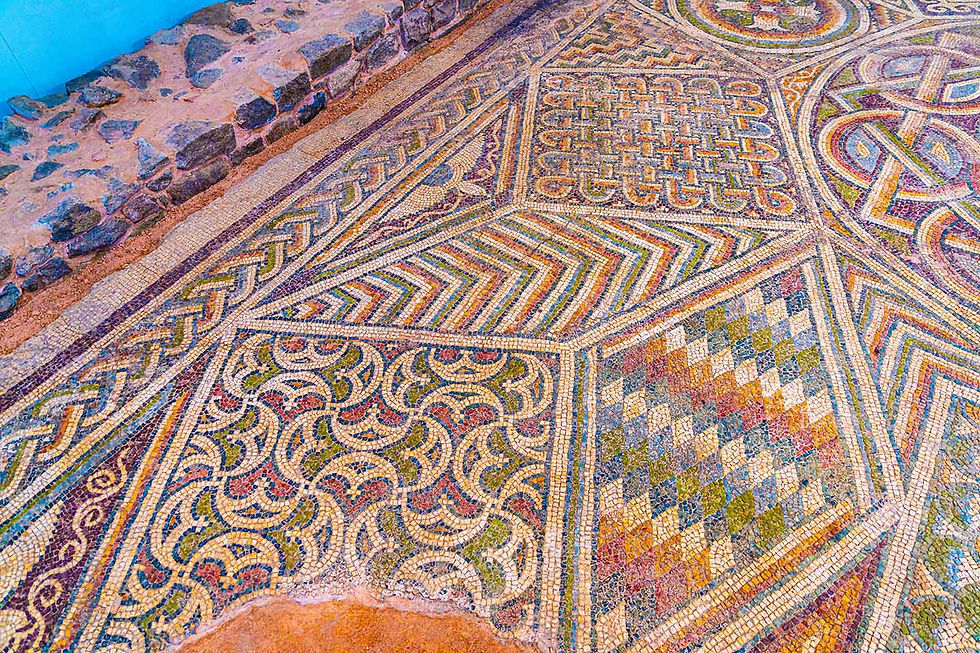
The floors of the Minor Basilica were covered with polychrome mosaic in all rooms, except for the chapel to the south, executed in the opus tessellatum technique, with geometric motifs prevailing in the nave and side aisles.

These geometric patterns are characteristic of early Christian basilicas and often symbolize divine order and infinity.

A pulpit was erected over the mosaic in the central nave and an altar screen was installed, which erased the first two lines of a donation inscription in Greek, placed with a specific frame (tabula ansata).
A baptistery (baptismal font) was built to the northeast corner of the basilica, in the floor of which a deep cross-shaped pool – piscina (piscina) was built. The baptistery was paved with bricks, on which a polychrome mosaic was later laid with images of two deer and a pair of birds framed by a latticework..
The mosaics of the Minor Basilica are included in the UNESCO Indicative List.
Function and type of baptistery
The baptistery with a cruciform piscina and figural mosaics in the Minor Basilica is the only preserved, restored and exhibited monument of this type in Bulgaria.

The piscina (from Latin piscina – artificial fish pond, pool) is a pool in which the sacrament of Baptism is performed. It is in the shape of a cross, with two of its arms having steps leading to the central, deepest square space. The other two arms of the cross – the northern and southern – are partitioned with marble slabs, which form a shallower level for the baptism of infants and young children.

The pool in the Minor Basilica is very early and was also intended for the baptism of adults.

The ciborium (from Latin ciborium – cup) is the marble colonnade that crowns the piscina. Ciboria appeared in Christian churches in the 4th-5th centuries. Initially, they served to secure a curtain over the altar table at certain moments of the service, and later they also covered pulpits, baptismal fonts and others.

The ciborium of the Minor Basilica has a square base with four arches resting on four columns.
The Mosaics
The mosaics cover the floors of all parts of the basilica from the first construction period (5th century) and are the work of local craftsmen. They were made in accordance with the technological requirements of the Roman mosaic technique, as is the case in most similar sites in Philippopolis.

The main laying technique is opus tesselatum. The tesserae are made of pebbles of different colors or of ceramics. Four more layers are laid under the mosaic: a drainage of broken stones and ceramic waste, a layer of mortar with crushed ceramics and two layers of mortar. The tesserae are laid on the top layer of fine pink mortar. Thanks to the high quality of workmanship, the mosaic has survived to this day despite repeated destruction - fire and the reconstruction of the basilica in the 5th - 6th centuries, the looting of the building material in the western half of the temple in the Middle Ages, the digging of pits for waste in the 10th - 12th centuries and the laying of a sewage system in the neighborhood in the 20th century.
The Baptistery Mosaic
The most significant artistic find in the complex is the mosaic from the Baptistery, an extension that emphasizes the importance of the sacrament of Baptism in this particular temple. This mosaic is distinguished by its exceptional color and a high degree of artistic mastery.

The iconographic focus is on images of animals, particularly deer and birds.

The image of the deer has a direct connection to Psalm 42:1.
As the hart panteth after the water brooks, so panteth my soul after thee, O God.
The mosaic symbolizes the spiritual aspiration of the baptized person towards God and the redemption through the water of baptism. The birds, in turn, probably symbolize the Holy Spirit, Paradise, or the Resurrection.

The technical realization of this mosaic is remarkable for the use of a rich array of tesserae, including red, ochre, green, white, light blue, black, brown and yellow. The use of eight different colors is not merely decorative, but represents a deliberate achievement of maximum aesthetic and theological saturation. This exceptional polychrome is designed to convey a sense of the beauty and glory of spiritual rebirth, which corresponds to the theological vision of the Garden of Eden (hortus conclusus) into which the newly converted enter.
The mosaic floor of the basilica dates back to the 5th century, and that of the baptistery to the beginning of the 6th century. Part of the mosaic of the basilica, as well as the piscina and the mosaic in the baptistery, have been preserved in situ, while the rest was dismantled in two campaigns (1993–1994, and again in 1998).
History of the mosaics
The mosaics of the Minor Basilica were discovered in 1991–1992, when the first emergency conservation was carried out. In 1993–1994, a team from the National Institute for Cultural Monuments removed half of the mosaics (about 50 square meters) from the site, leaving the rest in place. In 1995, the Minor Basilica, together with the nearby sector of the fortress wall, received the status of a Cultural Monument of National Importance. In 1998, after the completion of the last archaeological research, at the insistence of the Regional Archaeological Museum - Plovdiv, the Small Basilica was included in the "Beautiful Bulgaria" project, implemented with EU funds. The walls were partially strengthened, some of the mosaics remaining on the site were covered over, and the other part was dismantled.

In 2000, site archaeologist Mina Bospachieva and restorer Elena Kantareva, together with the Center for Art Conservation in Williamstown, Massachusetts, USA, received funding from the Trust for Mutual Understanding, New York, for a project to restore some of the mosaics. A mosaic around the pulpit, in the east and central parts of the north nave, and the entire mosaic in the baptistery have been preserved in situ. The mosaic in the central and north nave is covered with a thick layer of sand, and the baptistery is sealed with a lightweight concrete slab.
During the restoration, the main goal is to search for, collect, conserve, and exhibit all the mosaics, as well as the baptistery's piscina and architectural details in a kind of in situ archaeological museum.
Artistic dating
The complex design, high level of detail, and specific use of a rich color palette are explicitly associated with the era of the so-called Justinian Renaissance.

The chronological connection with the Justinian period (second half of the 5th to the 6th century) is critical. This dating, proposed by the researcher of the basilica and confirmed by the stylistic analysis of the mosaic patterns, places the decoration of the Minor Basilica in a period later than the upper layer of mosaics of the Episcopal Basilica. If the mosaics in the Episcopal Basilica are dated to the 5th century, then the mosaics in the Minor Basilica represent the next stage in the artistic development of Philippopolis.

This fact demonstrates the continued role of Philippopolis as a leading center of mosaic art in Thrace for more than a century. The high quality of workmanship characteristic of this period suggests either the existence of a local school supported by imperial resources, or the recruitment of craftsmen (tessellarii) directly from Constantinople or other major Byzantine centers. This investment in expensive and elaborate decoration is material evidence of imperial patronage and economic prosperity in the region during the reign of Justinian I.
The Role of the Basilica in Early Christian Church Life
The presence of a full set of liturgical elements – a syntron, an ambo, and an altar screen – indicates that the Minor Basilica was a fully functioning temple, capable of serving all the major sacraments. The ambo served for the reading of Scripture and preaching, making it a center of the Word, while the syntron provided a place for the higher clergy during the Eucharist.
The Ecclesiastical Landscape of Philippopolis
Analysis of the architecture and mosaics allows us to determine how the Minor Basilica fitted into the ecclesiastical structure of the city, dominated by the Episcopal Basilica. While the Episcopal Basilica represented the administrative and cathedral center (the seat of the metropolitan), the Minor Basilica probably fulfilled a specialized but key role.

The presence of a luxurious and iconographically charged baptistery suggests that this building may have been the main place for the public Sacrament of Baptism for the city or its eastern region. The intricate and costly mosaics in the baptistery are intended to enhance the drama and theological significance of the rite of initiation into the faith. In this way, the Minor Basilica functions as an important, but dependent, specialized institution within the diocese, complementing the functions of the cathedral.
Material reflection of Christian doctrine
The overall design of the basilica – from the narthex (the place of the catechumens), through the nave (the place of the faithful) to the sanctuary (the place of the clergy) – is a physical expression of the church hierarchy and the path of the believer. The luxurious marble and mosaic decorations served not only for aesthetics, but also as a visual confirmation of the greatness of the Christian faith and the status of Philippopolis as a significant Christian center in the Empire.
Imperial patronage and the apogee of the Justinianic era
The dating of the key decorative phase of the Minor Basilica to the Justinian Renaissance (6th century) is not accidental, but is directly related to imperial policy. Emperor Justinian I (527–565) was known for his grandiose program of building and strengthening cities in key provinces, as documented in De Aedificiis.

Philippopolis, as a vital administrative and military center located on the main road to Constantinople, was critical to the defense of the Eastern Empire against invasions from the north. Consequently, the city received significant funding for restoration and beautification. The costly polychrome mosaics in the Minor Basilica are a material symptom of this centralized imperial support and demonstrate the determination of the Justinian administration to maintain a high standard of living and an impressive ecclesiastical infrastructure in Thrace. The building activities and artistic commissions of this period are direct evidence of the high priority that the city had in the imperial strategy.
Philippopolis as a military and administrative center
The location of the basilica near the eastern fortress wall also emphasizes its connection with the military and defensive function of the city. In the mid-6th century, when barbarian raids became increasingly dangerous, maintaining solid fortifications and a well-functioning church network was vital to maintaining civic morale and loyalty to Constantinople.
The basilica was destroyed by fire and subsequently rebuilt without any significant change to the plan.
During this second construction period, the mosaic floor of the destroyed basilica was buried under the brick floor of the rebuilt building. After the fire, the floor was raised by 0.7 meters and, instead of mosaics, was now covered with bricks. Parts of the mosaic were destroyed when the foundations of its three-part narthex were laid.
The End of Antiquity and the Medieval Period
Despite its high prosperity and imperial funding, as attested by 6th-century mosaics, the fate of the Minor Basilica in the 7th century is a reflection of the general collapse of late antique urban life in Thrace.

After the death of Justinian and the intensification of pressure from the Avars and Slavs (especially in the late 6th and early 7th centuries), the imperial defense system collapsed. Philippopolis suffered severe demographic and economic shocks. The interruption of costly artistic commissions and the lack of subsequent large-scale archaeological layers related to the maintenance of the building point to its abandonment or a dramatic contraction of its functions.
It is not known whether the basilica was destroyed during the siege or simply abandoned due to the exodus of the population and the cessation of state subsidies, but after this period it ceased to function as a high-ranking liturgical center.
The Fate of the Basilica in Medieval Bulgaria
After the city fell into the orbit of the First Bulgarian State (after 681), the former monumental center of Late Antiquity experienced a period of deurbanization.

The probable fate of the Minor Basilica includes the demolition of the roof structure, the plundering of valuable materials (such as the marble altar screen and colonnades), and gradual filling in. Archaeological investigations above the floor indicate whether the site was converted into a medieval cemetery or was built over with more modest residential or farm buildings. Unlike some other sites that were transformed into smaller medieval churches, the Minor Basilica was probably abandoned, remaining only as a reminder of the magnificent Roman and early Byzantine Philippopolis.
Modern discovery, conservation and museum representation
The Minor Basilica was discovered and studied in the second half of the 20th centuryк.

Archaeological campaigns have succeeded in revealing the overall architectural plan, as well as establishing its chronology, linking the luxurious interior to the 6th century. The discovery of the almost intact mosaic in the baptistery was key to the reassessment of the artistic life of Philippopolis in Late Antiquity.
Conservation Methodology
The conservation of mosaics, especially the polychrome images of the baptistery, represents a serious technical challenge. These floors require specialized methods of reinforcement and protection, often involving the construction of protective museum structures over the ruins to regulate humidity and temperature, and prevent their further deterioration. The meticulous preservation of the eight-color palette of the tesserae is a top priority.
The Minor Basilica as a modern museum site
Institutionally, the Minor Basilica functions as an important component of the overall heritage of Roman mosaic art in Philippopolis. While the focus of central administration and visitor contacts is often on the larger Episcopal Basilica, the Minor Basilica offers a unique, specialized experience. It provides the clearest evidence of the high level of artistic craftsmanship characteristic of the late antique period under direct imperial influence.

The basilica is a critical chronological marker. It not only adds to the knowledge of the urban planning of Philippopolis, but also shows that even the smaller (albeit high-ranking) temples received the latest and most expensive decoration, confirming the continuity of cultural life until the early 7th century.
An exceptional monument
The minor basilica of Philippopolis is a monument of exceptional importance for the understanding of Christian ecclesiastical history and art in Thrace. Its archaeology reveals a three-aisled building of high liturgical status, demonstrated by the use of marble elements such as the syntron and the pulpit. Its location close to the eastern wall links it to the defensive and urban function of Philippopolis.
Its artistic heritage, especially the polychrome mosaic in the baptistery, is categorically dated to the Justinian Renaissance (late 5th–6th century). This dating testifies to the peak of imperial patronage and the influx of highly skilled craftsmen who created iconography rich in theological meaning (the deer and birds symbolizing Baptism). The high quality of the workmanship is a direct material indicator of the importance of Philippopolis as a strategic center in the Eastern Roman Empire.
The fate of the basilica in the 7th century serves as a vivid example of the catastrophic impact of the Slavic-Avar invasions, which led to an interruption of monumental construction and the decline of the urban infrastructure before the territory became part of Medieval Bulgaria. Today, the Small Basilica is an indispensable element of the Plovdiv museum complex, offering an in-depth look at the artistic culture and liturgical practice of the late antique metropolis.
The complete restoration and socialization of the Small Basilica was carried out in the period 2010 - 2013 with the support of the America for Bulgaria Foundation, the Ministry of Culture of the Republic of Bulgaria and the Municipality of Plovdiv.
Under the leadership of the restorer Elena Kantareva-Decheva, the dismantled fragments were searched for and subsequently processed (2011 - 2012), and after the construction of the protective building over the basilica (2010 - 2013), returned to their place (2013).

The Minor Basilica has been open to tourists since the beginning of May 2014.
In 1995 and 2018, the Minor Basilica of Philippopolis was declared an archaeological monument of culture with the category of national importance.
The Minor Basilica of Philippopolis is site number 41b of the Hundred National Tourist Sites of Bulgaria.
How to get to the city of Plovdiv?
Imagine a city that has seen thousands of golden sunrises and fiery sunsets, that has been a constant witness to the triumphant rise and inevitable and tragic fall of empires, and that today stands confidently, unwaveringly and majestically, telling its thousand-year history!

Welcome to Plovdiv – one of the most ancient cities in Europe!

Plovdiv is one of the best European tourist destinations!

Plovdiv is one of the best destinations for cultural tourism in Europe!

Brave travelers, get ready!
We will head to an extraordinary place where history is not just a series of dates, but if you reach out, you will touch it!

A place so old that it was born before legends, and so beautiful that it will steal your sleep!

When you step onto the smoothed cobblestones of the narrow winding streets of the Old Town, you can't help but feel the quiet and ancient breath of the past!

Every stone here, every house with carved facades, every hidden alley bears the imprint of Thracians, Romans, Byzantines, Bulgarians and Ottomans.

Plovdiv is not just another tourist destination!

Plovdiv is an experience like no other!

Plovdiv is a place where you can drink your morning coffee in a square where Roman legions once marched!

Plovdiv is a place where you can get lost among the Ancient Theater, which was a stage for gladiatorial battles and dramatic plays!

Plovdiv is a place where you can admire the purple sunset from Nebet Tepe – the hill where it all began millennia ago!

We will explore the impressive and silent Hissar Kapiya gate – the charismatic door to the heart of Plovdiv, guarding thousands of years of history, and its bright and recognizable symbol.
In Plovdiv we will pass through the Archaeological Complex of the Eastern Gate of Philippopolis - the most important and most used gate of the ancient city, as it was the main connection between it and Byzantium (the future Constantinople).

Plovdiv is a place where the museum complex "The Episcopal Basilica of Philippopolis" awaits you - a monumental cathedral, which with the impressiveness of its size and the splendor of its interior rivaled the largest sanctuaries in the Eastern Roman Empire!

Here, a huge canvas woven from millions of colorful tesserae has been painstakingly and carefully arranged – an endless carpet of indescribably beautiful mosaics!
But don't stop there! Just a few minutes away is the "Small Basilica of Philippopolis", which is the perfect addition to your journey through Ancient Plovdiv. Its secrets are worth every minute!
And to complete your journey into ancient luxury, continue to the Late Antique Building "Eyrene" (Irini)! Located in the middle of today's "Archaeological" underpass, it was one of the richest mosaic-covered private residences in the Eastern Balkans. Immerse yourself in the splendor of Roman Philippopolis!

Prepare your senses for a celebration - for the aroma of figs and old wood, for the whisper of centuries-old stones, for the bright colors of the Revival houses, and for the rhythmic pulse of a city that lives in harmony between antiquity and modernity!

Plovdiv will simultaneously enchant you, excite you, inspire you and make you fall in love!

Are you ready to immerse yourself in this fabulous reality?
Plovdiv is located:
161 kilometers (about 2 hours and 6 minutes by car) from the capital
376 kilometers (about 4 hours and 14 minutes by car) from the city of Varna
254 kilometers (about 2 hours and 24 minutes by car) from the city of Burgas
How to get to the Minor Basilica of Philippopolis?
The Minor Basilica of Philippopolis is located at 31, Princess Maria Luisa Blvd.
Dear friends, before I show you what interesting sights you can see nearby, I would like to remind you of the special photo album, which has collected incredible beauty and impressive photo moments just for you, a link to which you will find at the end of the post!
Enjoy it!
And finally, my dear friends,
you shouldn't miss checking out
the special photo album with moments –
discovered, experienced, filmed and shared with you!

Comments