
Recommended by "Photo Moments" - a guide to educational and unique journeys for students on the path to knowledge

Updated: Oct 28, 2025
Dear teachers, are you probably looking for interesting and educational places to visit with your students? Check out our suggestions for tourist sites that combine learning with fun. From amazing historical landmarks revealing forgotten Bulgarian chronicles to vast natural parks, here you will find unparalleled ideas for exciting routes.
Create unforgettable memories and ignite the thirst for knowledge in your students with "Photo Moments"! A whole world, filled with wonders, adventures and new discoveries, is waiting to be explored. From exciting interactive museums where learning becomes a game, through authentic architectural and historical reserves, gathering exceptional cultural and historical monuments, to magical natural corners that reveal the secrets of Bulgaria - "Photo Moments" offers you unforgettable journeys to places where fun and education go hand in hand.
We sincerely believe that learning can and should be fun! Our selection of educational and entertainment places for students is designed to stimulate their curiosity, develop their imagination and enrich their knowledge in a unique and fascinating way. Give students the opportunity to learn while having fun and discover the world around them through experiences that will inspire them for life.
Visits to historical, cultural and natural sites have been proven to stimulate curiosity, develop critical thinking and enrich the general culture of children.
Dear teachers, give your students the opportunity to see the world beyond the classroom! Gift them with memories for a lifetime!
So - where to go with students?
Pliocene Park in the village of Dorkovo is a remarkable paleontological museum, which is an excellent idea for an educational visit with students.
The site near Dorkovo is the largest known accumulation of bones from over 30 animal species in one place. Over 600 bones were found on an area of 15 square meters.
You can learn everything about the Pliocene Park in Dorkovo HERE.
History lessons can start from the fighting Bratsigovo.
During your stay in Bratsigovo, I recommend that you visit the tallest bell tower on the Balkan Peninsula, which is located in the courtyard of the church of St. John the Baptist.

Near the church you will find the small square "Sinjirli Bunar", shaped and built around the well, where on April 21, 1876, Vasil Petleshkov read the Call, the bloody letter and announced the uprising. The place is perfectly suitable for conducting an outdoor history lesson!

Erected in 1976 on the occasion of the 100th anniversary of the great events of the April Epic, the Apriltsi Memorial Park in the town of Bratsigovo is a cultural monument of local importance and I invite you to take time with your students to explore it.

Just 23 kilometers east of Bratsigovo (about 31 minutes by car) you will find charming Perushtitsa, where you can visit the Renaissance (Danovo) School.

Next to the school building is the church "St. Archangel Michael", inextricably linked to those memorable events of the April epic of the summer of 1876.

Just 15 kilometers southwest of the town of Peshtera (about 19 minutes by car) is the town of Batak.

In Batak, be sure to visit the historic church-ossuary "St. Nedelya".

In the city center is the Batak Historical Museum.

Nearby is the Balinovata House, which contains an ethnographic exhibition of the Batak Historical Museum.

Just 30 kilometers northeast of the town of Panagyurishte (about 38 minutes by car) is the beautiful, quiet and cozy village of Petrich, Zlatitsa municipality.

A walk through this wonderful Bulgarian corner is an incomparable pleasure and I highly recommend it!
What sights can students visit in the village of Petrich?
The "Bell" monument in the Boishteto area in the village of Petrich was erected as a tribute to the 172 inhabitants of the village who died in the pogrom of the April Uprising in 1876.

The "Bell" monument is located at the northern entrance to the village of Petrich.
A total of five rivers flow through the land of the village of Petrich - Topolnitsa, Mirkovska, Smolska, Kamenishka and Gugov dol, which flow their waters into each other. It is believed that it is this five-river system that gives the current name to the village.

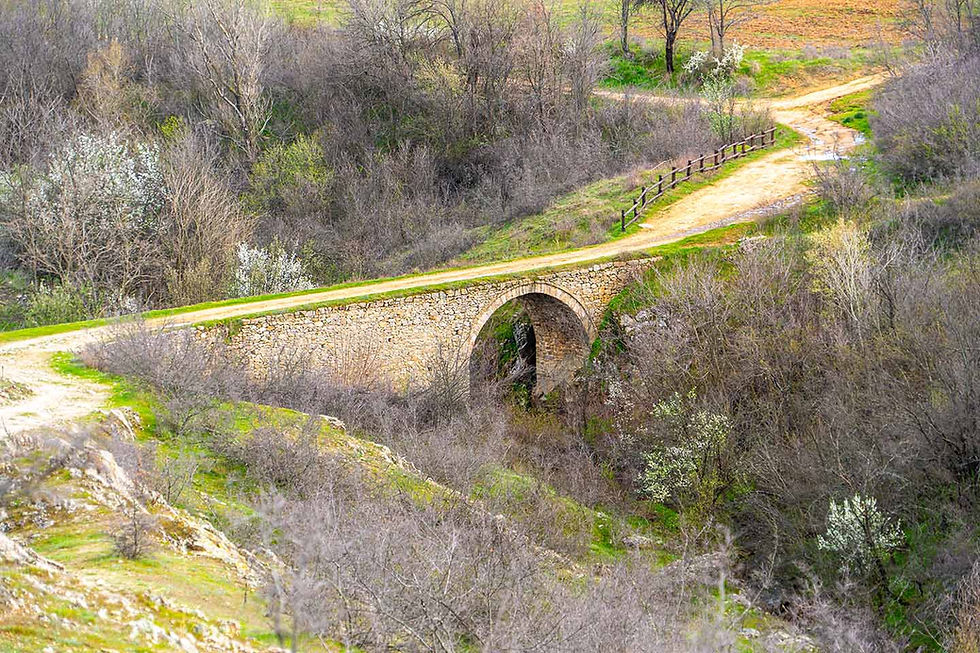
On your way to the center of the village, you will pass over the old double-arched bridge, towering over the turbulent waters of the Topolnitsa River.

Opposite the old bridge stands the Gugov's House - the restored home of Neno Lulchov Gugov, one of the active organizers and participants in the April Uprising of 1876 and a representative of the village in the Oborishte Assembly, after the Liberation of Bulgaria from Ottoman slavery.

Nearby is the sparkling jewel of the village of Petrich - the Art Gallery and its museum collection.

Currently, the Petrich Art Gallery houses an extremely valuable artifact - the personal medallion of the benefactor of the Bulgarian people, Lady Emily Strangford, who in 1877 gave it to the 27-year-old poet Ivan Vazov.

Lady Emily Strangford - a symbol of humanity, mercy, kindness, generosity and love for the Bulgarians, is a person who has been given a prominent place in the Art Gallery of the village of Petrich.

The areas of Petrina Chukara and Slivovka near the village of Petrich, Zlatitsa municipality, are associated with the first and only victory of the Hvarkovata Cheta of Voivode Georgi Benkovski over Bashibazouks and Circassians.

The monument in the Petrina Chukara area was erected and opened in 1976 on the occasion of the 100th anniversary of the uprising. It is also known as the monument "The First and Only Victorious Battle of the Hvarkovata Cheta".
The lessons of Bulgarian history continue!
Dear teachers, nearby is the town of Zlatitsa, where you and your students can visit the Zlatitsa Monastery - a refuge of Vasil Levski.

Nearby is the village of Chavdar, where I recommend you explore the Topolnitsa Archaeological Park.

Just 26 kilometers northeast of the Koprivshtitsa Architectural and Historical Reserve (about half an hour by car) you will find the historic town of Klisura.

Returning back to the Sub-Balkan Road, continue towards the city of Burgas.
You will soon see that the road forks. Continue straight, without taking the turn that will take you to the Sub-Balkan Road. From there, a path starts through the forest that will take you to the Apriltsi monument, towering in the Zli Dol area, erected in 1961 in honor of the 85th anniversary of those memorable events.

Just 56 kilometers east of the Koprivshtitsa architectural and historical reserve (about an hour by car), nestled in the southern foothills of the Stara Planina Mountains, lies the town of Karlovo. Here I recommend you take a walk to the Ethnographic Complex "Ancient Karlovo".
Just 5 kilometers west of Karlovo (about 6 minutes by car) is the town of Sopot.

Kalofer is located 17 kilometers east of Karlovo (about 19 minutes by car).

I suggest you head to a peak in the Stara Planina Mountains with an altitude of 1326 meters, located east of the Shipka Pass, which until November 23, 1951 bore the historical name of Saint Nicholas, then until October 7, 1977 - Stoletov Peak and since then - Shipka Peak. Here stands the Freedom Monument, known as the Shipka Monument.

Just 23 kilometers north of the Freedom Monument is the most beautiful architectural and ethnographic complex (AEC) and open-air museum - "Etar".

Be prepared, because you will find yourself in a world very different from the modern one – the world of the Bulgarians of the Bulgarian National Revival!
"Etar" houses the only collection of still-functioning folk watercraft in Bulgaria.
Just 16 kilometers from the city of Gabrovo (about 26 minutes by car) you will find the charming jewel of Bozhentsi, which is a must-see.

Just 30 kilometers south of Kalofer (about 44 minutes by car) you will find the beautiful Bulgarian Central Highlands jewel, the Svezhen Architectural and Historical Reserve.

22 kilometers south of AIR Svezhen (about 29 minutes by car) is the town of Brezovo. Here, you should not miss visiting the old school – one of the first secular schools in the Bulgarian lands.

Our joint educational walk, which you can take with your students, continues with a visit to the city of Hisarya and in particular the ancient fortress city of Diocletianopolis (also known as Diocletianopolis) - the pearl of balneotherapy in the province of Thrace of the Roman Empire.

Thanks to its incredible hot healing mineral springs, Diocletianopolis became one of the largest resort SPA centers at that time of the Roman Empire and flourished economically. It was visited by Caesars and notable, prominent Romans.
An ancient city in the resort of Hisarya has been declared an immovable cultural asset (cultural monument) with the category of national importance - archaeological reserve.
The Hisarya fortress, the fortress walls and the fortress facilities have been declared an immovable cultural asset (cultural monument) with the category of national importance - folk antiquity and an architectural and construction monument of culture from Antiquity and the Middle Ages.
In terms of its authenticity, preservation and originality of the fortification system and architecture, the Roman fortress city of Diocletianopolis ranks among the first places in Europe!
It is thanks to its hot mineral healing springs that the ancient fortress city of Diocletianopolis gradually became an ancient top SPA destination, respected and often visited by notable and important people, and that is why it was imperative, even mandatory, for the city to be protected from enemy attacks by erecting a massive defensive fortress wall, along which numerous battle fortress towers were located - 44 in total.
You can learn more about the defensive fortress wall of the ancient fortress city of Diocletianopolis HERE.
Of the former four grandiose massive main fortress gates through which one entered and exited the ancient city of Diocletianopolis, today the western and southern ones are the best preserved.

"Camels" - the majestic and impressive ruins of the former main southern fortress gate of the ancient city of Diocletianopolis, the pearl of balneotherapy in the Thrace province of the Roman Empire, are currently the brightest symbol of the city of Hisarya!
You will learn more about the main southern fortress gate of the ancient fortress city of Diocletianopolis HERE.
It is no secret that Hisarya is famous for its unique numerous healing hot mineral springs. It was so in ancient times, when these same springs gushed in these same places.
The Roman baths are located in the "Momina Salza" park and are part of the Roman residential complex, which covers an area of over 3,000 square meters. They were discovered in 1935. They are fed with hot mineral water from the "Toplitsa" spring.
You can learn more about the Roman baths (baths) of the ancient fortress city of Diocletianopolis HERE.
The ancient city was built according to all the requirements of Roman urban planning - with wide and straight streets (two main streets intersected at right angles in its center, and secondary ones ran parallel to them).
As a result of the long-term archaeological excavations, a large part of the buildings, the street network and the fortification system of the Roman city of Diocletianopolis have been studied, discovered and exhibited. Five necropolises (cemeteries) located outside the city limits have also been studied. Various types of tombs have been found in them, as well as many single graves.
Only the largest of them is exposed and accessible for visiting, and the only one with murals and floor mosaics. It is one of the most interesting architecturally and interiorly decorated late Roman tombs known to date in Bulgaria.
You can learn more about the Roman family tomb of the ancient fortress city of Diocletianopolis HERE.
I have included these Hissar landmarks, as well as many other interesting ideas, in five wonderful routes, which you can access by following the links via the following buttons:
Our educational walk, suitable for students, continues to the town of Pazardzhik, where you will discover the Garden of the World and the Eternal Flame of Peace.

Just 14 kilometers south of the town of Pazardzhik (about 19 minutes by car) is the village of Radilovo, where I recommend you visit the museum that preserves its rich history. The museum building is the only surviving hospital, built with funds donated by Lady Emily Strangford to treat the sick and injured from the brutal suppression of the April Uprising of 1876.

The people of Radilovo fondly preserve the memory of Lady Emily Strangford – a symbol of humanity, mercy, kindness, generosity and love for the Bulgarians. A rich exhibition dedicated to the life and work of Lady Emily Strangford is arranged in the Radilovo Museum.
We head to the outskirts of the Rila National Park, where we will visit the Beli Iskar eco-trail. It is a seven and a half kilometer long eco-trail, winding around the Beli Iskar River. The Beli Iskar eco-trail is a pleasant and easy walk, which you can walk quite calmly, without (almost) getting out of breath.

Dear teachers, the trail is ideal for conducting geography and biology classes!
You can learn everything about the "Beli Iskar" eco-trail HERE.
I remind you that each publication in the "RECOMMENDED" series is not complete and will be constantly updated with new travel ideas!
You can access our special publication "Recommended by "Photo Moments" - interesting and fun places to visit with children up to 6 years old" by clicking the following button:
We wish everyone a pleasant reading and fun adventures together!
You are reading a blog without advertising – fully focused on the content!
I remind you that you can read all my posts here – in "Photo Moments", without being interrupted by a single annoying advertisement, because "Photo Moments" is a place without advertisements!
I made the important decision to make "Photo Moments" ad-free so that my site can load much faster, the content I present to you can be as clean as possible and your experience in "Photo Moments" can be the best possible!
If you appreciate everything I do, you can support me HERE or by following the gold star below.
Thank you!


Comments