
Late Antique Building "Irini" (Eyrene) of Philippopolis – one of the richest in mosaics ancient residences in the Eastern Balkans

Updated: Jan 18
Post content:
And yet – Irini or Eirene?
Prolegomena: Philippopolis and the Context of Late Antiquity
The emergence of monumental Christianity
Chronology of the "Eyrene" complex
The rescue excavations of 1983-1984
Stratigraphy and dating
The Episcopal Residence Hypothesis
Architectural reconstruction and integration into the urban fabric
Insula Structure and Scope
Residential and representative parts
The specially built cardo
The mosaics of the Eirene
Detailed description of the polychrome floors
Stylistic and compositional analysis
Discovery of the local workshop
Comparative Analysis (Thracian Corpus)
The authentic section of the cardo in the underpass
Construction techniques and materials
The relationship between the street level and the foundations of the building
In situ conservation and museology in the contemporary context
The challenge of the underground
Engineering and Environmental Controls
The site as a museum
Integration within the UNESCO Tentative List
How to get to the city of Plovdiv?
How to get to the Late Antique Building "Irini" (Eyrene) of Philippopolis?
Beneath the centuries-old streets of today's Plovdiv lies a world woven from epic and captivating, mystical and secretive, inspiring and astonishing legends, imperial decrees and mysterious whispers of bygone greatness.

Among the most remarkable treasures discovered in the heart of ancient Philippopolis is the late antique building "Irini" (Eyrene)..

Ειρήνη in Greek means peace. It is pronounced irini. You would not be mistaken if you called it eirene.
This is also the name of one of the most remarkable buildings, which was a large Roman residence (called Domus Eirene), which ancient Philippopolis has bequeathed to us. It is hidden in the heart of the ancient city.
Imagine the moment when archaeologists uncover not just foundations and walls, but a picturesque story preserved by time – a mosaic of stone and glass, which shines with the same light as 1700 years ago.
The late antique building "Irini" is much more than an architectural monument. It is a time capsule, telling the story of elite life in the 4th - 6th centuries, a time of transition and Christianization of the Roman Empire.
Its perfectly preserved and masterfully crafted polychrome mosaic on the floor of the main representative hall (triclinium) with the face of a woman, next to whose image is written the name EIPHNH (Eirenes / Irene) in ancient Greek, despite all the historical vicissitudes, is quite impressive.

Get ready for a journey that will take you through the layers of the archaeological mystery, reveal the secrets of the imposing architecture and appreciate the miracle of modern conservation that has preserved this masterpiece for generations.
In this post, I will truly try to immerse you in the mysterious history of this unique complex, together we will examine the archaeological wonders it has bequeathed to us, and together we will follow the impressive path of its conservation and presentation to understand why Eirene is one of the brightest symbols of late antique Plovdiv.
Who was the mysterious owner of the building?
Why are its mosaics comparable to the best examples from the Eastern Roman Empire?
How do modern conservation techniques manage to keep it in perfect condition?
Are you ready to step through the threshold and experience the luxury of life in Philippopolis of Late Antiquity?
And yet – Irini or Eirene?
Variant | Pronunciation | Era and Context |
Eirene | Ey-re-ne (emphasis on Ey) | Ancient Greek (Attic dialect, Classical period). This is the authentic pronunciation of the name in antiquity, when the digraph EI was read as [ei] or [eý]. |
Irini | I-ri-ni (accent on the second I) | Byzantine and Modern Greek (Koine). This is the pronunciation used today. Over time, especially in Byzantium, the digraph EI (epsilon-iota) has shifted to the sound [i] (iotacism). |
Since the building in Philippopolis is late antique (3rd – 5th century AD), this is the period of transition, when the ancient Greek pronunciation had already begun to change to the Byzantine one.
"Eirene" would be more correct when talking about the name of the goddess from the classical ancient Greek myth or about the literal reading of the inscription from the mosaic, as it was written in Antiquity.
"Irini" is the more popular and modern way of reading the word, which is also used for the female name.
That is why today both options for naming the Late Antique building in Plovdiv are found.
Prolegomena: Philippopolis and the Context of Late Antiquity
Philippopolis, today's Plovdiv, occupied a strategic position as one of the leading cities in the Roman province of Thrace.

Its role increased significantly during the Late Antiquity period, especially after the Diocletianic reforms, when the city established itself as an important administrative, military and economic center, strategically located on the Via Militaris. This position led to the concentration of wealth and power, which was manifested in monumental urban construction, both in the public and private sectors.
The emergence of monumental Christianity
The next important factor determining the development of Philippopolis in the 4th and 5th centuries was the legalization and subsequent institutional rise of Christianity. This led to large-scale investments in the construction of large ecclesiastical structures, among which the Episcopal Basilica undoubtedly stands out.

In this context, the Late Antique Eirene building cannot be considered in isolation.
One of the most important observations arising from the archaeological data is the synchronicity of elite investments in the city.

The "Eyrene" building is dated to the 4th - 5th centuries, a period that coincides exactly with the time of the massive financing and construction of church architecture, including the Episcopal Basilica.

The architectural connection between these two sites suggests that the owner of "Eyrene" invested in or renovated his property at the same time as the greatest flowering of early Christian power in the city. This mutual connection points to the conclusion that the owner was a major patron or direct beneficiary of the growing status of the Church.
Chronology of the "Eyrene" complex
The discovery of the "Eyrene" building is the result of salvage archaeological excavations carried out in the period from 1983 to 1984 in the central part of Plovdiv.

The rescue excavations of 1983-1984
The need for these excavations arose in connection with the infrastructural development of the city.
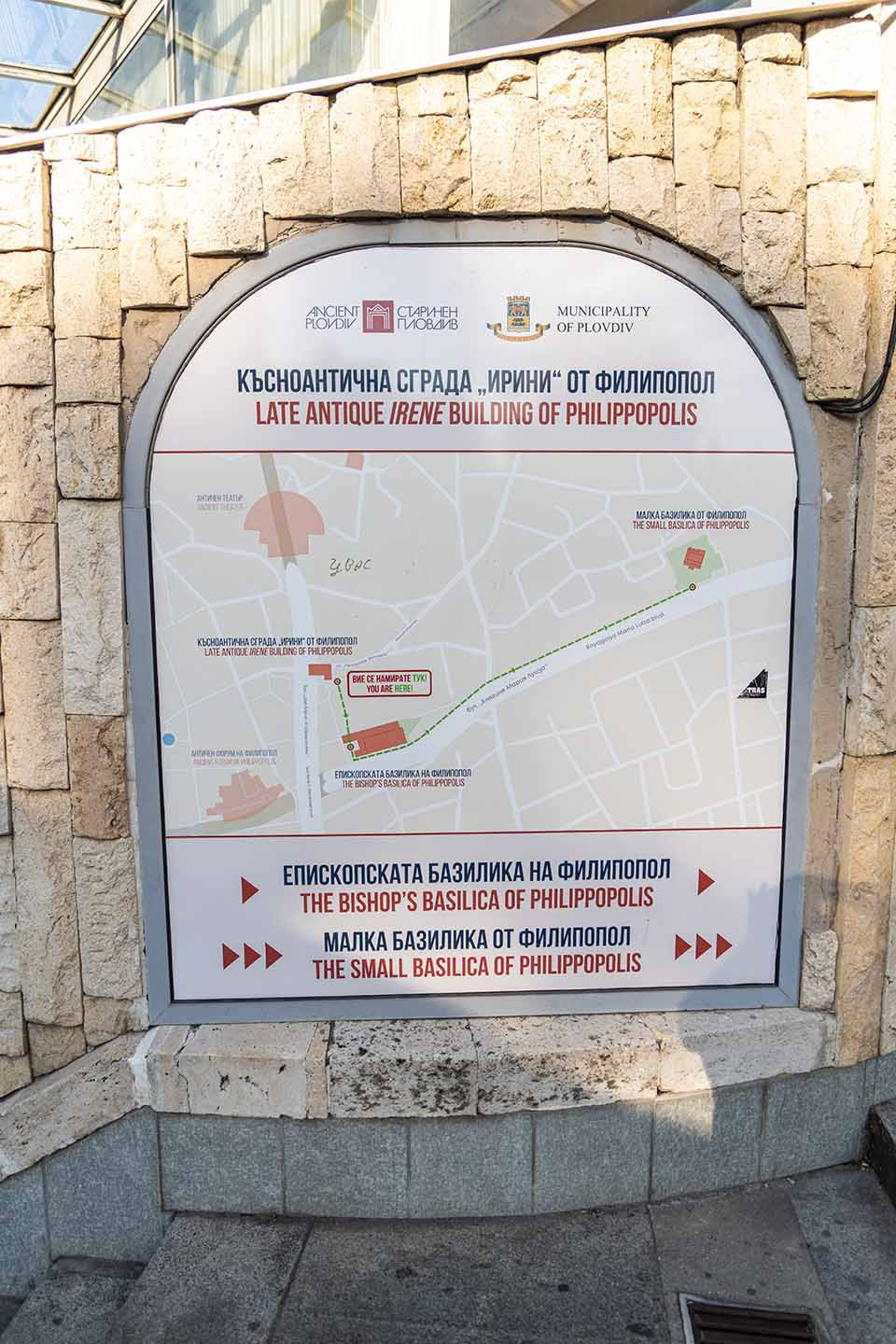
The site is located northeast of the ancient Forum and is in close proximity to the Episcopal Basilica. These rescue activities have required precise documentation and methodology, especially given the fragility of the in situ preserved mosaic floors.
Stratigraphy and dating
Based on stratigraphic analysis and the discovered artifacts, the main phase of occupation and flourishing of the building is established in the Late Antiquity period, covering the 4th and 5th centuries.

This dating positions "Eyrene" as a contemporary of the earliest monumental Christian buildings in Thrace.
The Episcopal Residence Hypothesis
The building is known as the Late Antique "Eyrene" building.

A key element in understanding its significance is the hypothesis that it functioned as the residence of the Bishop of Philippopolis. This hypothesis is based not only on its rich decoration, but also on its unique urban planning data.

The positioning of the building, although northeast of the Forum, is away from the traditional pagan administrative center of the city.

The building is positioned so as to be directly connected to the Episcopal Basilica. This shift in location from the old secular pagan core to the new monumental Christian axis – the Basilica and the Eirene Complex – is a tangible physical manifestation of the transfer of power in Late Antiquity from secular traditional bodies to the growing ecclesiastical structure. The location itself was a political statement about the new center of power.
Architectural reconstruction and integration into the urban fabric
The scale of the Eirene Complex clearly demonstrates the extraordinary wealth and status of its owner.

Insula Structure and Scope
The building occupied an impressive two-thirds of a city insula (block) in the center of ancient Philippopolis. This meant that either the merging of smaller plots or even the destruction of neighboring properties was necessary to create a single representative elite complex.

Occupying such a significant part of the insula elevates the residence from the category of a wealthy house to a palatial or administrative complex, suitable for the management of church affairs and the property of the bishop.
Residential and representative parts
The architectural design follows the classic model of Mediterranean elite residences, centered around a peristyle courtyard.

This courtyard was surrounded by porticoes and numerous rooms.
Archaeology clearly distinguishes the representative part, where the rooms with polychrome mosaic floors are located, from the more modest and functional residential and commercial premises.
The specially built cardo
The critical architectural evidence of the owner's exceptional status is contained in the urban planning intervention related to the main street. It has been established that a cardo (main city street, oriented north-south) was specially built to provide a direct connection between the Eirene building and the Episcopal Basilica.
Changes to infrastructure in a densely built-up city centre are expensive and extremely complex. The fact that a street was designed and built connecting the private residence directly to the public church centre is irrefutable evidence that the owner of Eirene wielded enormous social, and probably municipal, power.

This act of infrastructure investment confirms the elitist, and quite possibly episcopal, status, as it demonstrates control over the public resources necessary for such a large-scale urban change.
The mosaics of the Eirene
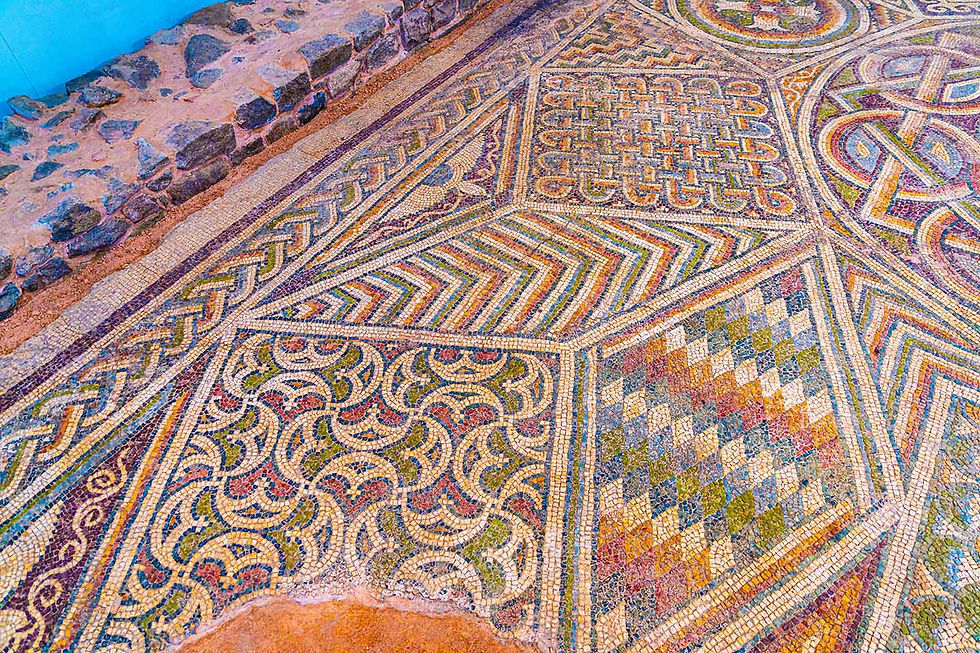
The floors of the representative rooms in the Eirene building are covered with polychrome mosaics, covering a total area of 160 square meters.

Detailed description of the polychrome floors
These mosaics are executed with exceptional craftsmanship and are a key element that defines the status of the building.

They are preserved in situ in the rooms around the peristyle courtyard.
Stylistic and compositional analysis
The artistic program is dominated by a variety of geometric ornamental patterns.

These models are richly complemented by floral and figurative images.

The use of complex compositions and a rich color palette place the mosaics of "Eyrene" among the highest level of Roman floor art from the period of Late Antiquity.
Discovery of the local workshop
One of the most significant archaeological discoveries in the complex is the presence of a furnace for the production of glass and smalt (colored glass material for brighter and more diverse tesserae) in the peristyle courtyard. This discovery is extremely rare, as it proves the functioning of a specialized, highly skilled mosaic workshop directly within the private residence.

The production of mosaics, especially those involving smalt, is a process that requires considerable resources, technical knowledge and skilled craftsmen. The discovery of the kiln on site proves that the owner had direct control over the entire production cycle, bypassing external supply chains. This control allowed for absolute quality assurance, speed of execution and protection of specialized techniques – traits characteristic of an extremely influential and technically informed elite patronage. It has been suggested that this workshop may also have contributed to the decorative program of the nearby Episcopal Basilica, which further supports the hypothesis of an episcopal residence and its control over regional artistic production.
Comparative Analysis (Thracian Corpus)
The mosaics of "Eyrene" are important for a comprehensive understanding of monumental art in the Roman province of Thrace.

They belong to the mid- to late 4th-century style and share characteristics such as scale of composition, ornamentation, size of tesserae, and partly color range with other significant late antique mosaic finds in the region.

Specific parallels can be drawn with the mosaic floors found in Diocletianopolis (present-day Hisarya), Augusta Traiana (present-day Stara Zagora), and Pautalia (present-day Kyustendil).

The mosaics of "Eyrene" serve as a benchmark for this regional artistic tradition. Their functional connection to the Basilica, through the specially constructed street, and their combined inclusion in the proposed UNESCO serial site "The Episcopal Basilica and the Late Antique Mosaics of Philippopolis" underline that their artistic value is inextricably linked to the historical context of the early Christian administration.
The authentic section of the cardo in the underpass
The "Eyrene" complex is preserved in situ, together with parts of the ancient street network.

This segment represents part of the cardo street bordering the insula, and probably includes the section of the specially constructed connection to the Episcopal Basilica.

Here I will allow myself to digress a little (but very slightly) and tell you more, showing you this interesting underpass in the city of Plovdiv, named "Archaeological".
"Archaeological" is a special underpass and is not like the other underpasses that can be found in most larger cities around the world and in our country. "Archaeological" is a real Roman street, located in an east-west direction, today parallel to "Patriarch Evtimiy" Blvd. and perpendicular to "Tsar Boris III Obedinitel" Blvd.
The stone that I have shown in the above photo moment and which is placed at the western entrance / exit of the underpass, is an authentic epigraphic monument from the Roman period of Philippopolis, exhibited in the "Archaeological" underpass next to the "Eyrene" building in Plovdiv.
This is a fragment of a votive or honorary marble slab (stele) that was embedded in the base of the Eirene building or is part of an exhibition illustrating architectural elements found in the area.
The inscription on the stone is in Ancient Greek, which was the official language of Philippopolis at the time. Although the monument is badly damaged, the most important fragment that directly links it to its location is visible at the end:
Visible keywords (this is my approximate transcription, as I was unable to find anything on the subject and I am now playing the role of Indiana Jones - may archaeologists forgive me if I am mistaken and applaud me loudly if I am right):
ΛΟΥΔΡΙ / ΛΟΥΔΡΙΣ (Ludri / Ludros – probably a personal name or part of it)
ΠΟΙΗΣΘΕΝΑ (Poisthene – "which was made/erected")
...ΕIΡΕ ΠΑΡΟΔΕΣ (Eire Parodes)
The phrase ΕIΠΕ ΠΑΡΟΔΕΣ is the most significant. ΠΑΡΟΔΕΣ (Parodes) in ancient Greek means "side road" or "passage / entrance".
This inscription is probably related to:
The street/passage: The phrase Parodes almost certainly refers to the Roman street (decumanus) that was discovered with the Eirene building and is part of the exhibition in the underpass. The inscription may have commemorated the construction or dedication of this street or part of the portico (colonnade) adjacent to it.
Eirene Building: The word EIPE (peace), which is also written as a name on the floor of the main representative hall (triclinium) with the face of a woman depicted in the central mosaic (and from which the building's name comes), is key. The Eirene Building was the residence of a prominent citizen (probably a bishop), whose construction began after the great devastation of the city by the Goths in 251 AD. During this period of reconstruction, many building activities were carried out, often marked with inscriptions.
Since the inscription is not complete and has been removed from its original location, its exact translation is impossible without consulting the catalog of the Plovdiv Archaeological Museum, but archaeologists have exhibited it precisely in this area to emphasize the connection between the residential building ("Eyrene" - peace) and the adjacent ancient street ("Parodes" - passage / road).
This is a great example of how Plovdiv integrates its millennial history into the modern urban space!

The preservation of the original street pavement (via level) offers valuable data on urban life and infrastructure from Late Antiquity.
Construction techniques and materials
The analysis of the preserved pavement section shows a typical construction for the large Roman urban arteries – a pavement of heavy stone slabs laid on a structured base. Curbs and clearly shaped sidewalk strips are also observed.
The relationship between the street level and the foundations of the building
The joint preservation of the architectural footprint of the "Eyrene", the interior decoration and the immediately adjacent public sphere (the ancient Roman street) provides a complete, vertical and horizontal snapshot of the late antique urban environment.

Unlike sites where the context has been lost, here the high degree of authenticity and integrity of the urban landscape have been preserved, which is invaluable for researchers studying urban development and daily life in Philippopolis in the 4th century.
In situ conservation and museology in the contemporary context
This is another amazing uniqueness from Bulgaria – the remains of the "Eyrene" building and the adjacent street network have been preserved and exhibited in situ in a modern pedestrian underpass called "Archaeological".
The challenge of the underground
The choice of this exact location for exhibition guarantees a high degree of accessibility for visitors, but at the same time creates significantкологични и структурни предизвикателства пред дългосрочната консервация.

The decision to preserve the highly sensitive polychrome mosaic floor in situ in a busy public area represents a high-risk, high-reward strategy.

The reward is an unparalleled visitor experience and a full understanding of the context; the risk is associated with potential environmental degradation and physical damage. This requires the application of specialized, integrated and often hidden maintenance and climate control systems.
Engineering and Environmental Controls
The conservation of the site requires the application of sophisticated conservation science adapted to the dynamic subsurface environment:
Vibration Mitigation – Structural isolation of the ruins from the heavy traffic passing along Tsar Boris III Obedinitel Blvd. is necessary.
Microclimate Management – Control of humidity and temperature fluctuations in the subsurface environment is critical. These parameters must be stabilized to prevent solidification, biological growth (mold) formation and freeze/thaw cycles, which are extremely damaging to ancient plasters and tesserae.
Drainage and prevention of water intrusion – protecting the ruins from modern water intrusion and elevated groundwater levels is of paramount importance for the preservation of the mosaic beds.
The site as a museum
Although integrated into the urban infrastructure, the site functions as a museum.

Integrating historical heritage directly into a functioning modern subway system requires the coexistence of archaeology with modern infrastructure. This approach makes history an unavoidable part of the daily life of travelers, which is in sharp contrast to traditional isolated museum settings. In this way, the Eirene complex serves as a successful model for how complex urban centers can reconcile deep archaeological layers with the needs of contemporary development.

A visit to the Eirene building provides an extremely detailed insight into the lives of the highest social and religious elite in Philippopolis during the 4th and 5th centuries. The arguments in support of its function as an episcopal residence are multi-layered and compelling: the architectural scale (two-thirds of the insula), the unique urban connection (the specially constructed cardo to the Basilica), and the control over artistic resources (the presence of a smalt kiln). These factors collectively demonstrate that the owner possessed not only exceptional wealth, but also unprecedented power to change the urban environment to his advantage.
Integration within the UNESCO Tentative List
The Eirene complex is an integral part of the serial site "The Episcopal Basilica and the Late Antique Mosaics of Philippopolis" nominated for the UNESCO World Heritage List.

Its inclusion is due to its functional connection with the Basilica and the fact that it is an exemplary representative of monumental late antique art and the earliest history of Christianity in the Thrace region.
The "Eyrene" building is an exceptional example of the successful integration of significant archaeological heritage into the modern urban structure.
In 1995 and 2018, the Archaeological Complex - Peristyle Building and Street Crossroads and the Late Antique Building Irini /EIPHNH/ were declared archaeological monuments of culture with the category of national importance.
The Late Antique Building "Irini" (Eyrene) of Philippopolis is site number 41b of the Hundred National Tourist Sites of Bulgaria.
How to get to the city of Plovdiv?
Imagine a city that has seen thousands of golden sunrises and fiery sunsets, that has been a constant witness to the triumphant rise and inevitable and tragic fall of empires, and that today stands confidently, unwaveringly and majestically, telling its thousand-year history!

Welcome to Plovdiv – one of the most ancient cities in Europe!

Plovdiv is one of the best European tourist destinations!

Plovdiv is one of the best destinations for cultural tourism in Europe!

Brave travelers, get ready!
We will head to an extraordinary place where history is not just a series of dates, but if you reach out, you will touch it!

A place so old that it was born before legends, and so beautiful that it will steal your sleep!

When you step onto the smoothed cobblestones of the narrow winding streets of the Old Town, you can't help but feel the quiet and ancient breath of the past!

Every stone here, every house with carved facades, every hidden alley bears the imprint of Thracians, Romans, Byzantines, Bulgarians and Ottomans.

Plovdiv is not just another tourist destination!

Plovdiv is an experience like no other!

Plovdiv is a place where you can drink your morning coffee in a square where Roman legions once marched!

Plovdiv is a place where you can get lost among the Ancient Theater, which was a stage for gladiatorial battles and dramatic plays!

Plovdiv is a place where you can admire the purple sunset from Nebet Tepe – the hill where it all began millennia ago!

We will explore the impressive and silent Hissar Kapiya gate – the charismatic door to the heart of Plovdiv, guarding thousands of years of history, and its bright and recognizable symbol.

In Plovdiv we will pass through the Archaeological Complex of the Eastern Gate of Philippopolis - the most important and most used gate of the ancient city, as it was the main connection between it and Byzantium (the future Constantinople).

Plovdiv is a place where the museum complex "The Episcopal Basilica of Philippopolis" awaits you - a monumental cathedral, which with the impressiveness of its size and the splendor of its interior rivaled the largest sanctuaries in the Eastern Roman Empire!

Here, a huge canvas woven from millions of colorful tesserae has been painstakingly and carefully arranged – an endless carpet of indescribably beautiful mosaics!
But don't stop there! Just a few minutes away is the "Small Basilica of Philippopolis", which is the perfect addition to your journey through Ancient Plovdiv. Its secrets are worth every minute!

And to complete your journey into ancient luxury, continue to the Late Antique Building "Eyrene" (Irini)! Located in the middle of today's "Archaeological" underpass, it was one of the richest mosaic-covered private residences in the Eastern Balkans. Immerse yourself in the splendor of Roman Philippopolis!
Prepare your senses for a celebration - for the aroma of figs and old wood, for the whisper of centuries-old stones, for the bright colors of the Revival houses, and for the rhythmic pulse of a city that lives in harmony between antiquity and modernity!

Plovdiv will simultaneously enchant you, excite you, inspire you and make you fall in love!

Are you ready to immerse yourself in this fabulous reality?
Plovdiv is located:
161 kilometers (about 2 hours and 6 minutes by car) from the capital
376 kilometers (about 4 hours and 14 minutes by car) from the city of Varna
254 kilometers (about 2 hours and 24 minutes by car) from the city of Burgas
How to get to the Late Antique Building "Irini" (Eyrene) of Philippopolis?
I invite you - forget for a moment the noisy modern center of Plovdiv!
Look for and find the "Archaeological" underpass.
The Archaeological Underpass is a pedestrian underpass that is strategically important for connecting the two parts of the center of Plovdiv, separated by one of the busiest boulevards.
The underpass passes under Tsar Boris III Obedinitel Blvd. – a central transport artery that separates the northern and southern parts of the center.
The underpass connects two very different in character, but key areas of Plovdiv:
🟢 East End (Towards the Old Town)
Princess Maria Luiza Street
Saborna Street (pedestrian street leading up to the Old Town).
This part provides pedestrian access to:
The foot of the Trihills and the beginning of the Architectural Reserve of Ancient Plovdiv.
Dzhumayata (the Roman Stadium and Dzhumaya Square).
🔵 West End (Towards Main Street)
Gladstone Street (pedestrian street).
The central pedestrian zone of Plovdiv (called the "Main").
Central Square (where the Central Post Office, the Trimontium Hotel and the recently restored archaeological complex with the Ancient Forum are located).
In other words, the "Archaeological" underpass is one of the main bridges that connects the Ancient and Renaissance Plovdiv (the Old Town) with the Modern, administrative and commercial center (the Main Street).
It is in this underpass that the unique clash of eras is visible - the traffic of the 21st century passes over the heads of passers-by, while the foundations of the dwellings and streets of Philippopolis from the 4th - 5th centuries are preserved under their feet!
Unique!
Amazing!
Inspiring!
The late antique building "Irini" (Eyrene) of Philippopolis is located at the eastern entrance / east of the archaeological underpass in the center of Plovdiv and is one of the richest in mosaics ancient residences in the Eastern Balkans.
Behind the glass windows lies part of an ancient residential district, dominated by an unusually rich and luxurious residence.
Dear friends, before I show you what interesting sights you can see nearby, I would like to remind you of the special photo album, which has collected incredible beauty and impressive photo moments just for you, a link to which you will find at the end of the post!
Enjoy it!
And finally, my dear friends,
you shouldn't miss checking out
the special photo album with moments –
discovered, experienced, filmed and shared with you!

Comments